
I love this headline: Small, Isolated Elephants Follow Own Evolutionary Path.

Funerals are so funny
My friend said, "Funerals are so funny. My daughter and I went to one of those ceremonies, one month after, or chautha or something, and everyone was sitting in white saris, with their pallus over their heads, and they were playing these Sanskrit hymns, but the tunes were film songs! You know that song from Sangam with Raj Kapoor…? We both started giggling. I was sitting cross-legged on the floor, so I bent over and rested my arms on my knees, and hid my face so no one could see me laughing. And someone came up behind me and patted my shoulder and said, 'Don't cry, it's God's will.'"
I love this headline: Small, Isolated Elephants Follow Own Evolutionary Path.
I love this headline: Small, Isolated Elephants Follow Own Evolutionary Path.

Here's why 'hoarding' (billboard) painters have almost disappeared from Chennai: Glamorous billboards are changing the city's skyline. In the near future you'll hardly be able to see buildings and trees anymore.
Several Things
What a Google referral I got yesterday!

A friend is visiting from Delhi, which has changed her. She came home yesterday, bringing a gift: a copy of Eckhart Tolle's The Power of Now: a Guide to Spiritual Enlightenment. She felt sure that we must have heard of it, if not already read it, because in Delhi Everyone has read it. In fact, in Delhi Everyone is heavily into spirituality these days. She herself has become a devotee of Reiki (Japanese healing practise). She has husband-and-wife Reiki gurus in Delhi, and credits them with changing her life. One of them is clairvoyant, so she can ask questions about the future too.
She said, "If you meditate every day you can glimpse Nirvana." Ramesh said, "I'm having glimpses of Nirvana just from listening to you, but what good is it? I'm still perspiring." She dismissed this with a contemptuous wave of her hand, and said, "The trouble with you is that you don't want to be happy. If you want to be happy you can be. That's it."
Later the subject of suicide came up. She said, "It's come out now, from someone who knows: if you commit suicide you have to come back seven times, and under very bad circumstances. And that's a fact. So don't even think about it."
Since she had the Now, the future, and even the next lives under such firm control, we began to feel somewhat spiritually inferior. So we went out to dinner and talked about less freighted issues, like the Kashmir situation.
I bought three books yesterday: P.D. James' The Murder Room, Monica Ali's Brick Lane (shortlisted for a Booker Prize), and Popular Indian Art: Raja Ravi Varma and The Printed Gods of India, by Erwin Neumayer and Christine Schelberger. (I had earlier linked to a review.)
The latter is full of wonderful popular lithographs of gods and politicians. According to the jacket blurb, "This book is the fascinating story of how modern printing techniques transformed the face of art and imagery in India, catapulting mythical and popular images within the reach of ordinary people..."
I happen to own one of the lithographs shown in the book:

I found this picture a little creepy - Ganesh's very human fleshiness. But I liked the fond embrace, which looks more Western than Indian to me. Anyway, it's a wonderful book - just the kind of thing I like.
aishwarya picture for a magazine in which she shows his breast and she took millions dollar of thatThe Aishwarya referred to is of course the filmstar Aishwarya Rai. Good luck to you! (And why do I keep getting referrals for 'pron'?)
A friend is visiting from Delhi, which has changed her. She came home yesterday, bringing a gift: a copy of Eckhart Tolle's The Power of Now: a Guide to Spiritual Enlightenment. She felt sure that we must have heard of it, if not already read it, because in Delhi Everyone has read it. In fact, in Delhi Everyone is heavily into spirituality these days. She herself has become a devotee of Reiki (Japanese healing practise). She has husband-and-wife Reiki gurus in Delhi, and credits them with changing her life. One of them is clairvoyant, so she can ask questions about the future too.
She said, "If you meditate every day you can glimpse Nirvana." Ramesh said, "I'm having glimpses of Nirvana just from listening to you, but what good is it? I'm still perspiring." She dismissed this with a contemptuous wave of her hand, and said, "The trouble with you is that you don't want to be happy. If you want to be happy you can be. That's it."
Later the subject of suicide came up. She said, "It's come out now, from someone who knows: if you commit suicide you have to come back seven times, and under very bad circumstances. And that's a fact. So don't even think about it."
Since she had the Now, the future, and even the next lives under such firm control, we began to feel somewhat spiritually inferior. So we went out to dinner and talked about less freighted issues, like the Kashmir situation.
I bought three books yesterday: P.D. James' The Murder Room, Monica Ali's Brick Lane (shortlisted for a Booker Prize), and Popular Indian Art: Raja Ravi Varma and The Printed Gods of India, by Erwin Neumayer and Christine Schelberger. (I had earlier linked to a review.)
The latter is full of wonderful popular lithographs of gods and politicians. According to the jacket blurb, "This book is the fascinating story of how modern printing techniques transformed the face of art and imagery in India, catapulting mythical and popular images within the reach of ordinary people..."
I happen to own one of the lithographs shown in the book:

Ganesh and his two wives, c. 1910
I found this picture a little creepy - Ganesh's very human fleshiness. But I liked the fond embrace, which looks more Western than Indian to me. Anyway, it's a wonderful book - just the kind of thing I like.

Navaratri
The festival season is in full swing. In fact, there are so many festivals that I tend to lose track. I went out yesterday and saw many broken gourds in the road, so I knew something was up. I discovered that it was the first day of Navaratri. (One invokes the evil that has accumulated in one's house or shop into a gourd, then carries it out to the road and breaks it. All the evil leaves you and goes into the road. And in fact, the gourds' flesh is slippery, and is a real hazard to bicyclists and motorcyclists.)
Navaratri, during which Goddesses are worshipped in several forms, is going on from September 25 to October 5.
During Navaratri Gujaratis dance the garba or dandiya-raas, a dance in which one holds a stick (danda) in each hand, and claps the sticks in rhythmic patterns against those held by one's partner.
In Tamil Nadu, people set up kolu stands, seven-stepped platforms filled with dolls representing the world -- gods at the top, mythical beings, humans, animals, etc. lower down. (This link also includes Navaratri recipes -- page down.)
Listen to Gujarati Navaratri songs.
Read advice on how to be popular while performing dandiya-raas.
More here and here.
Navaratri, during which Goddesses are worshipped in several forms, is going on from September 25 to October 5.

During Navaratri Gujaratis dance the garba or dandiya-raas, a dance in which one holds a stick (danda) in each hand, and claps the sticks in rhythmic patterns against those held by one's partner.
In Tamil Nadu, people set up kolu stands, seven-stepped platforms filled with dolls representing the world -- gods at the top, mythical beings, humans, animals, etc. lower down. (This link also includes Navaratri recipes -- page down.)
Listen to Gujarati Navaratri songs.
Read advice on how to be popular while performing dandiya-raas.
More here and here.
What Her Girlfriend Said
A Tamil poem from the Sangam Period (100 BC - AD 250), from A. K. Ramanujan’s Poems of Love and War:
What Her Girl Friend Said
consoling her when she was distressed by the town's gossip
If it rains,our town grows rich.
Ears of grain
cluster on the paddy grass
maned like horses.
When it's dry,thorn bushes rise by the black waters,
the mud is parched.
But the dark shallows
yield a harvest of white salt.
Full of old ceremony,this ancient town of ours
is always rich,
has kitchen smoke from frying fish
wafting through the streets
and on the beach
where tiny flowers dot the tigerclaw trees.
Yet, I must say, it has one fault.
The bees get high on the pollen
in the groves of black-branched laurel
and hum so loud
it's hard to hear the bells
of his tall chariot
when it comes.
Uloccanar
Narrinai 311
Village Goddesses, Tomatoes and Onions
Yesterday I posted an article about the Tamil village deities. One of the most powerful, who exists in the north as well as the south, is Mariamman, who used to rule over smallpox. (The north Indian equivalent is named Sheetal, which means 'coolness.') Now that smallpox has been eradicated, she must content herself with measles and chicken-pox.
When my old cook's grandson came down with one or the other of those, she told me that he 'had' Mariamman. She treated it by pouring water on his body for coolness, and applying turmeric paste. She knew that it would go away in ten days.
Later, our gardener came down with Mariamman. He treated it by wrapping a cloth around his shoulders and carrying a sprig of neem leaves near his face; the air which passes neem is supposed to be cooler and more salubrious than ordinary air.
(This gardener, Rajamanikkam, later caused us a lot of pain. He was with us for ten years, from when he was about 16. He was the most intelligent and resourceful of the people who have worked in our house, but at some stage he decided to steal. Padding the vegetable prices a little is almost universal, and one generally overlooks it; but tools began to disappear, and then it became clear that he was taking a commission from the repairmen who came to the house. Finally, he stole money from a drawer I had left unlocked, and we realised that we had to fire him.
He had married the housemaid, Pungudi, so she went with him. Worse than that, Pungudi's relatives in the nearby slum were known to practise black magic. Rajamanikkam went to the cook and told her that she had to quit too, or they would put a spell on her. The house emptied overnight. Only the Nepali watchman remained. He was frightened, but one of his hands is clenched up and paralysed, and he probably can't get another job.
I had to hire new staff, the people who are with us now. The cook came back after six months, and worked for us until she died of a heart attack last year. It's still hard to think about Rajamanikkam, and I miss his small son, Shanmugam. Rajamanikkam took Shanmugam vegetable shopping on his bicycle every day. One day when he was still a toddler I walked into the kitchen, and found him waving the cloth shopping bag and chanting "Thakkali vengayam! Thakkali vengayam!" ("Tomatoes and onions! Tomatoes and onions!")
When my old cook's grandson came down with one or the other of those, she told me that he 'had' Mariamman. She treated it by pouring water on his body for coolness, and applying turmeric paste. She knew that it would go away in ten days.
Later, our gardener came down with Mariamman. He treated it by wrapping a cloth around his shoulders and carrying a sprig of neem leaves near his face; the air which passes neem is supposed to be cooler and more salubrious than ordinary air.
(This gardener, Rajamanikkam, later caused us a lot of pain. He was with us for ten years, from when he was about 16. He was the most intelligent and resourceful of the people who have worked in our house, but at some stage he decided to steal. Padding the vegetable prices a little is almost universal, and one generally overlooks it; but tools began to disappear, and then it became clear that he was taking a commission from the repairmen who came to the house. Finally, he stole money from a drawer I had left unlocked, and we realised that we had to fire him.
He had married the housemaid, Pungudi, so she went with him. Worse than that, Pungudi's relatives in the nearby slum were known to practise black magic. Rajamanikkam went to the cook and told her that she had to quit too, or they would put a spell on her. The house emptied overnight. Only the Nepali watchman remained. He was frightened, but one of his hands is clenched up and paralysed, and he probably can't get another job.
I had to hire new staff, the people who are with us now. The cook came back after six months, and worked for us until she died of a heart attack last year. It's still hard to think about Rajamanikkam, and I miss his small son, Shanmugam. Rajamanikkam took Shanmugam vegetable shopping on his bicycle every day. One day when he was still a toddler I walked into the kitchen, and found him waving the cloth shopping bag and chanting "Thakkali vengayam! Thakkali vengayam!" ("Tomatoes and onions! Tomatoes and onions!")

our current cook, Mary, buys vegetables at the gate;
the land across the street is shown on the map as 'open jungle',
but it's been filled in and levelled for a building site
(sorry, it's an awful photograph -- unless one admires garbage dumpsters)
Sanskritisation
There was a very interesting article in the September 21 New Indian Express, 'Sanskritisation: The new ritual?' by B. Kolappan. Unfortunately, I didn't find it on the Express website, so I'm posting the first half of it here (the second half mainly concerns relations between Hindus and Christians of the Nadar community - another story). But first some background:
According to the newspapers, there has been a law against animal sacrifice on the books since the 1950's. But, mainly in the southern parts of Tamil Nadu, where the oldest forms of religion are strongest, animal sacrifice has been practised in the temples of 'village' or 'folk' deities since ancient times. The animals sacrificed today are goats, pigs and chickens, and they are eaten after the sacrifice. In the last few weeks, the government has begun to enforce the law, stopping temple festivals in several places, and preventing the shamans of some temples from performing rituals connected to animal sacrifice. (This is not an issue at all, as far as I know, in the cities, where ritual offerings include milk, ghee, flowers and fruits.) The issue immediately became politicised. Opponents of the government claimed that enforcement of the law was aimed at suppressing Dravidian culture, and discriminates against the lower castes which have traditionally carried out this practise. One (brahmin) politician said that if animal sacrifice was banned, the upper caste offerings (milk, ghee, etc.) should also be banned. At the same time, others praised the government for stamping out a primitive practise, and for preventing cruelty to animals. It's a vexed issue.
Meanwhile, the process of assimilation between the dominant strain of Hinduism which came down from the north, and the indigenous religion, has been going on for many centuries. One method was to connect local gods to the Vedic gods by family relationship: the Tamil goddess Meenakshi was married to the Vedic god Shiva. The Tamil god Murugan was identified with one of Shiva's sons, Karthikeya, etc. This article brought the past into the present for me:
According to the newspapers, there has been a law against animal sacrifice on the books since the 1950's. But, mainly in the southern parts of Tamil Nadu, where the oldest forms of religion are strongest, animal sacrifice has been practised in the temples of 'village' or 'folk' deities since ancient times. The animals sacrificed today are goats, pigs and chickens, and they are eaten after the sacrifice. In the last few weeks, the government has begun to enforce the law, stopping temple festivals in several places, and preventing the shamans of some temples from performing rituals connected to animal sacrifice. (This is not an issue at all, as far as I know, in the cities, where ritual offerings include milk, ghee, flowers and fruits.) The issue immediately became politicised. Opponents of the government claimed that enforcement of the law was aimed at suppressing Dravidian culture, and discriminates against the lower castes which have traditionally carried out this practise. One (brahmin) politician said that if animal sacrifice was banned, the upper caste offerings (milk, ghee, etc.) should also be banned. At the same time, others praised the government for stamping out a primitive practise, and for preventing cruelty to animals. It's a vexed issue.
Meanwhile, the process of assimilation between the dominant strain of Hinduism which came down from the north, and the indigenous religion, has been going on for many centuries. One method was to connect local gods to the Vedic gods by family relationship: the Tamil goddess Meenakshi was married to the Vedic god Shiva. The Tamil god Murugan was identified with one of Shiva's sons, Karthikeya, etc. This article brought the past into the present for me:
Sanskritisation: The New Ritual?
Will the Tamil Nadu government's ban on animal sacrifice pave the way for the entry of Vedic culture into folk temples?
by B. Kolappan
Appi, a trance-dancer at a temple devoted to folk deity Sudalai Madan, is the protagonist of the short story Maadan Motcham, by noted Tamil writer Jeyamohan. The story is about how the upper caste Namboodiris from Kerala appropriate Sudalai Madan and sideline Appi.
When they are invited to perform rituals, the first thing the Namboodiris ensure is that non-vegetarian food is not prepared. Sudalai Madan, who devours non-vegetarian food after consuming litres of arrack or toddy has to content himself with the sweet prepared by them. The smell of the vegetarian food makes him sick and he feels like throwing up. He complains to Appi, who is more of a companion to him. But, Appi is helpless.
As the angry Sudalai Madan, holding his weapon, tries to jump from his pedestal to take revenge on the Namboodiris he realises that he too is under the spell of the powerful Vedic mantras and cannot move an inch.
Jeyamohan's story captures the process of Sanskritisation, a term coined by sociologist M N Srinivas. It describes the way the lower castes tend to imitate the customs and rituals of the upper layers in order to gain social respectability. The Tamil Nadu government's recent ban on animal sacrifice in temples could be called an attempt at imposing Sanskritisation on the non-Brahmin communities. Such a ban can cut off the umbilical chord that links a Sudra [member of a low caste] with his own god as happens in the case of Appi. Critics argue that it will pave way for the entry of Vedic culture and Brahmin priests into the folk temples. It may also lead to the assimilation of folk deities with Vedic religion.
This Sanskritisation process is already going on at a frenetic pace in Kanyakumari district, the most literate region in the state. And various social upheavals are taking place there. To start with, folk gods are being fast replaced by Vedic gods.
Vedic and folk gods are poles apart. Except for the Brahmins, every other community has temples dedicated to their favourite folk gods and goddesses. Madan is a generic name and there are a whole lot of Madans, like Sudalai Madan; Pula Madan and Esaki Madan. Goddesses include Mutharamman, Sandhana Mari Amman, Muppidari, Kali and Durgai. The priest of the temple is usually from the community that owns the temple.
These deities are different from the Vedic ones. They are gruesome and evoke fear in the minds of their devotees; not love. They have to be propitiated at regular intervals. Festivals are organised twice a year and animal sacrifices are an integral part of these celebrations. The sacrifices are known as Muppali (killing of three animals, generally goats, fowls and pigs).
The idols are made of sand and lime. Even the temples housing such deities look quite ordinary, a simple structure under tiled roofs, with nothing to distinguish them from the devotees' residences. In many Sudalai Madan temples even the roofs are a luxury. There is no such thing as a sanctum sanctorum in these temples, clearly differentiating them from the Brahminical concept of ritual purity.
But all this is changing now. Sudalai Madan, his fraternal deities and their temples are undergoing a dramatic transformation, signalling the arrival of the Brahminical culture. This, in a region where the dominant, Nadar community, a backward caste, has fought a running battle against the atrocities of the varnashrama dharma [the caste system]. The irony is that today concrete miniatures of Vedic temples, with gopuram and a vimana above the sanctum, are coming up everywhere. Granite images of gods and goddesses are replacing the structures erected from sand and lime. The purpose of installing a granite structure is to perform abhishekam (ritual pouring of liquids) as done in Vedic temples. Once the construction of a new temple is over, kumbabhishekam, consecration, is by Vedic scholars, totally alien to the folk gods and those that worship them. The gods and goddesses who once evoked so much fear are now referred with a prefix "arul migu" (merciful), a misnomer. Every Nadar village has a magnificent temple modelled after Vedic temples. Economically a dominant community, they lavish a lot of money on temple construction and other festivals.
Once derisively referred to as the chanars (toddy tappers), the womenfolk of the community were never allowed to cover the upper portion of their bodies. Their plight was considered worse than that of Dalits [untouchables]. The struggle to get the rights to cover the breasts is etched in blood in the annals of the community and described as the historic "thol seelai (pullav) struggle." The oppression by the upper castes in fact led to large scale conversion to Christianity....

Chennai Billboards in Berlin
Three Chennai billboard painters went to the Asia-Pacific Week fair in Berlin last week. They brought with them 20 billboards, and painted another one on the spot. Here's the article, according to which
for painting 60-feet tall billboards, the artist is handed images on an A-4 size paper. He is expected to execute the magnification. About 4,000-5,000 people in Chennai drew sustenance from the art till just about a year ago. Six studios employing 30 painters last year dwindling to 4 studios employing 4 people shows up an art facing the threat of total extinction.

one of the Chennai billboards, centre
Ragini
I got a Google referral for 'visual embodiments of ragas.' These are called Ragamalas and Raginis. Here is an explanation, from Indian Paintings from the Virginia Museum of Fine Arts:
And also:
And:
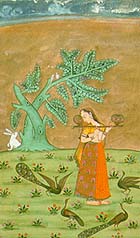
Here are some examples of Raginis, from here and there on the Net:
There are more Raginis here,
here (seven Raginis), here, here, here, here, here, here, here, here (a number of Raginis), and here (several Raginis).
Ragamala paintings are part of an extraordinary artistic union of paintings, poetry, and music. Ragas, the musical basis of the relationship, are very old musical forms that over time have been classified into "families" of themes and modes. They evoke certain moods, are performed at specific times of the day, and they are considered personalities (heroes, heroines, or deities).
Poets began writing about ragas in the 14th century. Their verses interpreting this music were almost as varied and wide-ranging as the ragas themselves. Painters in turn portrayed the poems, capturing the moods or personality of the ragas' characters or themes. These paintings made up sets of Ragamalas ("Garlands of Ragas"), usually in groups of thirty-six or forty-two.
And also:
Ragamalas are organized in several systems and grouped in families consisting of a male raga at the head with several raginis, or wives and often include sons called ragaputras, and daughters or ragaputris. (from Princes, Poets and Paladins)
And:
Ragamala paintings... are attempts to make an abstract thought concrete. A raga, an Indian musical form, is an audible form created to express emotions, sensations, or feelings. Similiarly, ragamala paintings are emotions expressed through a plastic form. Some ragamalas express the temperment of seasons, others beauty, or love and devotion. The verbal descriptions, which are often found as part of the paintings, express the spirit of the raga. They describe the subject, the characterstics of the raga and the literal expression of the painting through the verses. (from Hurst Gallery)
Here are some examples of Raginis, from here and there on the Net:

Ragini Karnati (circa 1790), from Chandra and David's Homepage

Bikaner, Patamanjari Ragini, ca. 1640, from Va. Museum of Fine Arts

Ragini Bangala, c 1725, from AIIS, Varanasi
(one of four Raginis on this page; and what looks like a very interesting site)

Todi Ragini, from Va. Museum of Fine Arts

Kausa Ragaputra, Punjab Hills, Mankot, c. 1700 -- The hot intensity of mid-seventeenth and early eighteenth-century paintings produced in the courts of the Punjab Hills at Mankot, Basohli, Bahu, and Kulu, is evident in this Ragamala painting of a princely character and his consort seated on a carpet, each with a bird perched on a finger. This ragaputra is the "son" of the raga Malkos or Malavakasika whose iconography often contains a seated lord accompanied by his consort. From Harvard University Art Museums (one of two raginis from 'Princes, Poets and Paladins')
There are more Raginis here,
here (seven Raginis), here, here, here, here, here, here, here, here (a number of Raginis), and here (several Raginis).

A Couple of Things
I was watching Mehbooba (1976), a Hindi film in the sub-genre of janam-janam saathi -- lovers whose bond is so strong that they keep meeting up, one lifetime after another.
How nice, to believe that if you screw up in this life you have another one -- many others -- to play around with.
It's a silly movie, but there's a beautiful song, Mere naina saavan-bhadon... 'My eyes are full of tears, but still my heart is thirsty...' This kind of intense romanticism generally arouses skepticism in me, but with the beautiful melody and the beautiful voice of Kishore Kumar, the lyrics also seemed beautiful.
Saavan-bhadon literally names two months of the year, which are the monsoon months -- like saying 'my heart is February-March,' when you want to say 'My heart is very cold.'
I tried to write an English ghazal once, which failed -- but there was one bit I liked:
Such a beautifully written blog: Zellar: Open All Night. I wish I could write like this, so ... open, so large. It looks easy, but it's not. Never fails to surprise me.
And while I'm at it, what about adieu.nu? Bruised and inward and noir-ish.
I'm so grateful when I read work like this.
How nice, to believe that if you screw up in this life you have another one -- many others -- to play around with.
It's a silly movie, but there's a beautiful song, Mere naina saavan-bhadon... 'My eyes are full of tears, but still my heart is thirsty...' This kind of intense romanticism generally arouses skepticism in me, but with the beautiful melody and the beautiful voice of Kishore Kumar, the lyrics also seemed beautiful.
Saavan-bhadon literally names two months of the year, which are the monsoon months -- like saying 'my heart is February-March,' when you want to say 'My heart is very cold.'
I tried to write an English ghazal once, which failed -- but there was one bit I liked:
My eyelashes glisten with shards
splintered from my heart.
Such a beautifully written blog: Zellar: Open All Night. I wish I could write like this, so ... open, so large. It looks easy, but it's not. Never fails to surprise me.
And while I'm at it, what about adieu.nu? Bruised and inward and noir-ish.
I'm so grateful when I read work like this.
From Sanskrit Poetry From Vidyakara's Treasury, translated by Daniel H. H. Ingalls:
"Who spoiled the painting on your breast
and the collyrium of your eye?
Who took the lipstick from your lip
And the garland from your hair?"
"That which, washing off all men's impurity,
of hue is blue as waterlily."
"Who, Krishna?" "No, the water of the Jumna.
It's you that are in love with Krishna."
Chennai Chic
Yesterday we decided to go on a rare outing. We drove to one of the expensive shopping areas of the city, Khader Nawaz Khan Road. First I ran into Naturally Auroville, and bought some bleu cheese, and cottage cheese, and dried lemongrass - all products of Auroville, the international community founded by followers of Shri Aurobindo, just outside of Pondicherry.
(When I first arrived here, in 1986, the only cheese available was a tasteless, rubbery item called Cooking Cheese. At one stage I actually ordered cheese-making supplies from The New England Cheesemaking Supply Co. and made a not-bad gouda, aged in the refrigerator. Now we have Mozzarella, and Swiss, and cream cheese (marketed as Malai Chaska), and American cheese - the kind where each thin slice is wrapped in its own plastic sheet. And imported tins of Brie. Incroyable. I still have to dream of goat cheese, though. Goats are commonly eaten here -- goat-meat is called mutton -- but when I tried to buy goats' milk and make some of my own, I found that each lactating goat provides about a thimbleful of milk, beyond what it supplies to its kids -- I would have needed a whole herd.)
After Naturally Auroville, we moved on to Movenpick, where we perched on bleached wooden chairs and ate panini, followed by ice cream imported from Switzerland.
Does it seem strange to import ice cream from Switzerland? Read this:
After Movenpick we went to Barista, a coffee pub, and lolled there for awhile, drinking something called icepresso.
Barista is right next to Evoluzione, a new furniture store that sells Ligne Roset. You can buy a love-seat for Rs. 125,000 - an enormous amount. I don't know if anyone is really buying, though. When I went in to take a look one day, the only customer was a prosperous-looking Sindhi lady, who perched on the edge of a sofa that folded over like a sheet of paper. She looked irritated, and said to the salesgirls, "You mean it doesn't even come with a centre table? And what discount do you give?"
After all this we returned, fed and caffeinated, on the chaotic streets, while I planned to make pasta with bleu cheese and coconut milk-lemon grass-and-ginger sorbet.
So, we have all this in Chennai too - not just the crumbling, broken things that appeal to me. And we have buildings like this:
More and more of them spring up like mushrooms from the fertile mulch of the city of the past.
(When I first arrived here, in 1986, the only cheese available was a tasteless, rubbery item called Cooking Cheese. At one stage I actually ordered cheese-making supplies from The New England Cheesemaking Supply Co. and made a not-bad gouda, aged in the refrigerator. Now we have Mozzarella, and Swiss, and cream cheese (marketed as Malai Chaska), and American cheese - the kind where each thin slice is wrapped in its own plastic sheet. And imported tins of Brie. Incroyable. I still have to dream of goat cheese, though. Goats are commonly eaten here -- goat-meat is called mutton -- but when I tried to buy goats' milk and make some of my own, I found that each lactating goat provides about a thimbleful of milk, beyond what it supplies to its kids -- I would have needed a whole herd.)
After Naturally Auroville, we moved on to Movenpick, where we perched on bleached wooden chairs and ate panini, followed by ice cream imported from Switzerland.
Does it seem strange to import ice cream from Switzerland? Read this:
IT was in 1833 that the Tudor Ice Company of Boston sent its first ice ship to India. The clipper, Tuscany, arrived in Calcutta (now Kolkata) on September 6, with 180 tonnes of ice wrapped in pine sawdust that remained intact in blocks even after a four-month-long journey. For the next 40 years, the export ice trade from the US prospered in India till the advent of mechanical refrigeration which sounded its death knell. Tudor was the pioneer of the ice trade not only in India but the world over. In the 1850s, the North-Eastern States of the US exported as much as 150,000 tonnes of ice a year...
After Movenpick we went to Barista, a coffee pub, and lolled there for awhile, drinking something called icepresso.
Barista is right next to Evoluzione, a new furniture store that sells Ligne Roset. You can buy a love-seat for Rs. 125,000 - an enormous amount. I don't know if anyone is really buying, though. When I went in to take a look one day, the only customer was a prosperous-looking Sindhi lady, who perched on the edge of a sofa that folded over like a sheet of paper. She looked irritated, and said to the salesgirls, "You mean it doesn't even come with a centre table? And what discount do you give?"
After all this we returned, fed and caffeinated, on the chaotic streets, while I planned to make pasta with bleu cheese and coconut milk-lemon grass-and-ginger sorbet.
So, we have all this in Chennai too - not just the crumbling, broken things that appeal to me. And we have buildings like this:

Tidel Park
More and more of them spring up like mushrooms from the fertile mulch of the city of the past.
This is unusual -- who pays attention to Gandhi these days? -- Read Gandhi and reform, HC tells MLA
CHENNAI SEPT. 17. In order to make him `realise his duties as MLA', the Madras High Court today directed B. Ranganathan (Purasalwalkam) to stay in Madurai for five days and read Gandhian literature in the Gandhi Museum library there. Justice M. Karpagavinayagam, granting him anticipatory bail in a case of criminal intimidation, said the `inevitable conditions were to create a proper atmosphere (for Mr. Ranganathan) to reform and equip himself to be a fit person for serving the constituency as well as the people at large'...The Changing Face of the Bindi: What some women are wearing on their foreheads these days.
Shri Marundeeswarar Temple
I wrote this a year ago. It's meant to describe to an outsider like myself what it's like to visit a South Indian temple (I'm not a great photographer -- and I didn't take any pictures inside the walls of the temple. There's a much better picture of a typical South Indian temple gopuram than the one I took here):
Thiruvanmiyur used to be a small village on Chennai's southern outskirts. Now it is a suburb. Its only distinguishing features are Kalakshetra (where I was a student for two years, long ago) and a temple of Shiva in the form of Marundeeswarar, the Lord of Medicine.
The temple was built in the 11th c. AD. According to the temple history, the sage Agastya came to Shiva with a terrible stomach ache. Shiva cured him, and taught him medicine. He also cured the ailing sun and moon, as a result of which they both worship Shiva here every day. The doorway of the god's inner sanctum faces west, because the sun worships him at sunset. Most Shiva temples include shrines to the nine planets, including sun and moon. This temple does not, because the sun and moon themselves are worshippers. Valmiki, author of the epic Ramayana, prayed here for Shiva to appear before him. Shiva did so, and there is a shrine which marks the spot.
Outside the temple is a tank, a square artificial pond with stone steps leading down on all four sides. In the center is a square 'island', also reached by steps, just large enough for a stone pavilion. When I came here years ago, I watched women doing their laundry, boys playing, men bathing. Red lotuses floated on the surface of the water.
Now the tank was dry. Five or six goats ate scrubby grass at the bottom. People had thrown garbage there, amid which white plastic shopping bags gleamed. I parked in an open expanse of soft dust in front of the temple. A brown chicken ran in front of my car. There were more goats, and people resting in the shade of a few trees.
When you face the temple, the first thing you see is a tall gopuram, a roughly triangular tower five or six storeys high, covered with figures: gods, goddesses, terrifying protective deities, arranged in tiers like a wedding cake, all painted in vivid colours. Pigeons flutter in its nooks and crannies.
The gopuram rises over a tall green double door, studded with heavy bolts. This gateway is in the middle of a red-and-white striped wall around the temple compound. White-painted bulls sit on top of the wall. The bull, Nandi, is Shiva's vehicle and also his greatest devotee.
There is another dry tank in front of the temple, smaller, with broken, uneven steps. [Note: The two tanks have been renovated since I wrote this, partly in an attempt to recharge the water table, which has sunk dramatically because of overuse due to population increase.] At one end of the tank another Nandi faces a small shrine.
A man sold strings of marigolds and jasmine beside the main door. Worshippers kept their shoes under a rickety lean-to.
As I walked toward the temple I followed an elderly lady heading in the same direction. Her grey hair was pulled back in a tight bun. She wore a rose-coloured cotton sari with a yellow border, and a gold and diamond jewel on one nostril. She left her sandals in the lean-to and walked to the shrine beside the neglected tank. She faced the deity, joined her hands, prayed, circled the shrine clockwise. The deity was a lingam, the abstract phallic symbol which is the most common representation of Shiva. It was draped in white cloth. Tiny lamps -- mud cups filled with oil and cotton wicks -- burned in front of it.
I also circled the shrine, and followed the lady to the main temple door. People were entering in a steady trickle, some of them touching the high stone threshold with their right hands, and raising their hands to their heads.
From outside, the gopurams (there were two, over the east and west gates) gave an impression of massiveness and height. But across the threshold was open space and human dimensions. A number of one-story stone buildings were set in a large dirt courtyard, covering about an acre. The principal buildings were: Shiva's shrine, divided in two parts for two different forms of the same god; two small shrines in front of the main one, for Shiva's two sons; and, on the right, a shrine for Shiva's consort. A number of minor shrines were scattered around the compound.
Of the two sons, Ganesh, the elephant-headed Remover of Obstacles and God of Beginnings, was the more popular. All the worshippers stopped to pray to him on their way to the main building. Many performed a gesture which is reserved for Ganesh: cross your arms over your chest; from there, reach your hands up to grasp your earlobes, so that your crossed arms represent elephant ears; bend your knees and bob up and down three times. A priest was stationed with a round brass tray which held an oil lamp, cow dung ash, and flowers. As the worshippers came up he waved the tray in front of the god, then held it out. Each person cupped both hands palm down over the flame, then moved their hands in the air over their faces and the tops of their heads. The priest gave each one some ash to put on their foreheads, and a flower petal.
The first chamber of the main temple was an open hall supported by thirty six pillars carved with deities. Wooden carriages for temple processions were stored there: fantastic birds, lions, lotus blossoms, all brightly painted; and a special swinging palanquin for Shiva's annual marriage ceremony. There was also an intriguing noise-making machine: two small kettle-drums with metal drumsticks poised, two bells, two cymbals, and a motor to set everything in motion.
At the end of this pillared hall was a shrine to Shiva as Tyagaraja Swami, in human form. This was the god which was taken outside the temple during festivals. The shrine was a building within the building, made so the devotees could circle it.
From Tyagaraja's hall I turned right and entered the shrine to the main deity, Shri Marundeeswarar. This was the largest room in the temple. It also contained a separate building inside for the god's sanctum. It was dim, lit by sunlight from the pillared hall, and by dozens of oil lamps. Shri Marundeeswarar was in the form of a black stone lingam, almost completely covered with jasmine garlands and surrounded by oil lamps. The worshippers stand behind railings and peer into the sanctum, lit only by the flickering lamps, so the god seems withdrawn and mysterious. This lingam is supposed to have risen from the earth. The Divine Cow Kamadhenu used to shower the lingam with milk, and there's a nick where a hoof grazed it. The priest goes inside, waves his brass tray in front of the god, brings it out along the railing to the worshippers.
I circled the sanctum, which was surrounded by a stone gutter. The priests bathed the gods every day, before dressing and decorating them, and the gutter was still wet from the morning bath. On special days there were elaborate baths. During Shiva's annual festival the lingam was bathed with water and shikakai (a pre-soap herbal cleanser), then with honey, milk, yoghurt and navamrta (nine fruits mixed together). Women could bring their gold jewellry to the temple, and the priests would put it on the lingam and bathe it along with the lingam. The bathed jewellry was 'good for health.' People sponsored special baths, and offered clothing to the gods.
I walked outside to continue my clockwise trip around the compound. Cows were tethered near the wall, to provide milk, ghee and cow dung for the rituals. An old priest and a young one sat side by side on the ground with a book. Both were bare-chested except for the Brahmin's sacred thread, and wore white dhotis. The old man chanted a Sanskrit verse, the young one repeated it.
I passed the west gate, surmounted by its gopuram. I could see the barred opening into the main shrine -- oil lamps and darkness -- for the setting sun to worship Shiva.
Further on, a platform surrounded the temple tree. It was ancient, its trunk partly hollowed but alive, fragrant, surrounded with naga stones, fertility deities. These were tombstone-shaped, carved with twining snakes. They were decorated with flowers, and smeared heavily with yellow turmeric and red sindoor. More oil lamps burned in front of them. A man stood praying to them, singing a hymn under his breath.
Finally I visited Shiva's consort, Tripurasundari, which means "Beautiful Woman of the Triple City (of the gods)." Her shrine followed the same pattern as the others: the goddess in her small chamber within a larger pavilion, almost hidden under a silk sari and flowers, the priest with his tray of oil lamp, ash, flowers. I sat cross-legged on the goddess's stone front porch for awhile, along with several other women, writing my notes.
In the years when I studied here the gods seemed so close, even though they weren't mine. People kept smaller versions at home, worshipped them, bathed and dressed them. The Southern classical music tradition consists entirely of hymns. Everyone knew the stories of gods' activities on earth. God appeared (in his complete form: the temple forms contain the divine, but the divine is larger than they are) on this very spot, right here, see? The Divine Cow's hoof grazed Shiva and left this mark, here! I still know intellectually that to some people the gods are immanent, available; sitting on the porch of Tripurasundari's shrine, I could feel for a moment how it must be.
Thiruvanmiyur used to be a small village on Chennai's southern outskirts. Now it is a suburb. Its only distinguishing features are Kalakshetra (where I was a student for two years, long ago) and a temple of Shiva in the form of Marundeeswarar, the Lord of Medicine.
The temple was built in the 11th c. AD. According to the temple history, the sage Agastya came to Shiva with a terrible stomach ache. Shiva cured him, and taught him medicine. He also cured the ailing sun and moon, as a result of which they both worship Shiva here every day. The doorway of the god's inner sanctum faces west, because the sun worships him at sunset. Most Shiva temples include shrines to the nine planets, including sun and moon. This temple does not, because the sun and moon themselves are worshippers. Valmiki, author of the epic Ramayana, prayed here for Shiva to appear before him. Shiva did so, and there is a shrine which marks the spot.
Outside the temple is a tank, a square artificial pond with stone steps leading down on all four sides. In the center is a square 'island', also reached by steps, just large enough for a stone pavilion. When I came here years ago, I watched women doing their laundry, boys playing, men bathing. Red lotuses floated on the surface of the water.
Now the tank was dry. Five or six goats ate scrubby grass at the bottom. People had thrown garbage there, amid which white plastic shopping bags gleamed. I parked in an open expanse of soft dust in front of the temple. A brown chicken ran in front of my car. There were more goats, and people resting in the shade of a few trees.
When you face the temple, the first thing you see is a tall gopuram, a roughly triangular tower five or six storeys high, covered with figures: gods, goddesses, terrifying protective deities, arranged in tiers like a wedding cake, all painted in vivid colours. Pigeons flutter in its nooks and crannies.
The gopuram rises over a tall green double door, studded with heavy bolts. This gateway is in the middle of a red-and-white striped wall around the temple compound. White-painted bulls sit on top of the wall. The bull, Nandi, is Shiva's vehicle and also his greatest devotee.

looking toward the gopuram over the east gate from the south.
Nandis sit on top of the wall
There is another dry tank in front of the temple, smaller, with broken, uneven steps. [Note: The two tanks have been renovated since I wrote this, partly in an attempt to recharge the water table, which has sunk dramatically because of overuse due to population increase.] At one end of the tank another Nandi faces a small shrine.
A man sold strings of marigolds and jasmine beside the main door. Worshippers kept their shoes under a rickety lean-to.
As I walked toward the temple I followed an elderly lady heading in the same direction. Her grey hair was pulled back in a tight bun. She wore a rose-coloured cotton sari with a yellow border, and a gold and diamond jewel on one nostril. She left her sandals in the lean-to and walked to the shrine beside the neglected tank. She faced the deity, joined her hands, prayed, circled the shrine clockwise. The deity was a lingam, the abstract phallic symbol which is the most common representation of Shiva. It was draped in white cloth. Tiny lamps -- mud cups filled with oil and cotton wicks -- burned in front of it.

the small tank to the left of the east gate,
with Nandi, under a stone canopy, facing a shrine
I also circled the shrine, and followed the lady to the main temple door. People were entering in a steady trickle, some of them touching the high stone threshold with their right hands, and raising their hands to their heads.
From outside, the gopurams (there were two, over the east and west gates) gave an impression of massiveness and height. But across the threshold was open space and human dimensions. A number of one-story stone buildings were set in a large dirt courtyard, covering about an acre. The principal buildings were: Shiva's shrine, divided in two parts for two different forms of the same god; two small shrines in front of the main one, for Shiva's two sons; and, on the right, a shrine for Shiva's consort. A number of minor shrines were scattered around the compound.
Of the two sons, Ganesh, the elephant-headed Remover of Obstacles and God of Beginnings, was the more popular. All the worshippers stopped to pray to him on their way to the main building. Many performed a gesture which is reserved for Ganesh: cross your arms over your chest; from there, reach your hands up to grasp your earlobes, so that your crossed arms represent elephant ears; bend your knees and bob up and down three times. A priest was stationed with a round brass tray which held an oil lamp, cow dung ash, and flowers. As the worshippers came up he waved the tray in front of the god, then held it out. Each person cupped both hands palm down over the flame, then moved their hands in the air over their faces and the tops of their heads. The priest gave each one some ash to put on their foreheads, and a flower petal.
The first chamber of the main temple was an open hall supported by thirty six pillars carved with deities. Wooden carriages for temple processions were stored there: fantastic birds, lions, lotus blossoms, all brightly painted; and a special swinging palanquin for Shiva's annual marriage ceremony. There was also an intriguing noise-making machine: two small kettle-drums with metal drumsticks poised, two bells, two cymbals, and a motor to set everything in motion.
At the end of this pillared hall was a shrine to Shiva as Tyagaraja Swami, in human form. This was the god which was taken outside the temple during festivals. The shrine was a building within the building, made so the devotees could circle it.
From Tyagaraja's hall I turned right and entered the shrine to the main deity, Shri Marundeeswarar. This was the largest room in the temple. It also contained a separate building inside for the god's sanctum. It was dim, lit by sunlight from the pillared hall, and by dozens of oil lamps. Shri Marundeeswarar was in the form of a black stone lingam, almost completely covered with jasmine garlands and surrounded by oil lamps. The worshippers stand behind railings and peer into the sanctum, lit only by the flickering lamps, so the god seems withdrawn and mysterious. This lingam is supposed to have risen from the earth. The Divine Cow Kamadhenu used to shower the lingam with milk, and there's a nick where a hoof grazed it. The priest goes inside, waves his brass tray in front of the god, brings it out along the railing to the worshippers.
I circled the sanctum, which was surrounded by a stone gutter. The priests bathed the gods every day, before dressing and decorating them, and the gutter was still wet from the morning bath. On special days there were elaborate baths. During Shiva's annual festival the lingam was bathed with water and shikakai (a pre-soap herbal cleanser), then with honey, milk, yoghurt and navamrta (nine fruits mixed together). Women could bring their gold jewellry to the temple, and the priests would put it on the lingam and bathe it along with the lingam. The bathed jewellry was 'good for health.' People sponsored special baths, and offered clothing to the gods.
I walked outside to continue my clockwise trip around the compound. Cows were tethered near the wall, to provide milk, ghee and cow dung for the rituals. An old priest and a young one sat side by side on the ground with a book. Both were bare-chested except for the Brahmin's sacred thread, and wore white dhotis. The old man chanted a Sanskrit verse, the young one repeated it.
I passed the west gate, surmounted by its gopuram. I could see the barred opening into the main shrine -- oil lamps and darkness -- for the setting sun to worship Shiva.
Further on, a platform surrounded the temple tree. It was ancient, its trunk partly hollowed but alive, fragrant, surrounded with naga stones, fertility deities. These were tombstone-shaped, carved with twining snakes. They were decorated with flowers, and smeared heavily with yellow turmeric and red sindoor. More oil lamps burned in front of them. A man stood praying to them, singing a hymn under his breath.
Finally I visited Shiva's consort, Tripurasundari, which means "Beautiful Woman of the Triple City (of the gods)." Her shrine followed the same pattern as the others: the goddess in her small chamber within a larger pavilion, almost hidden under a silk sari and flowers, the priest with his tray of oil lamp, ash, flowers. I sat cross-legged on the goddess's stone front porch for awhile, along with several other women, writing my notes.
In the years when I studied here the gods seemed so close, even though they weren't mine. People kept smaller versions at home, worshipped them, bathed and dressed them. The Southern classical music tradition consists entirely of hymns. Everyone knew the stories of gods' activities on earth. God appeared (in his complete form: the temple forms contain the divine, but the divine is larger than they are) on this very spot, right here, see? The Divine Cow's hoof grazed Shiva and left this mark, here! I still know intellectually that to some people the gods are immanent, available; sitting on the porch of Tripurasundari's shrine, I could feel for a moment how it must be.

A Traffic Ticket
I got a notice from the Traffic Police that I had run a red light in Adyar - four months ago! - and must pay Rs. 50 or face prosecution. I didn't remember anything about it, but I looked up the address of the Adyar branch of the Traffic Police in my map - Dr. Muthulakshmi Road - and set off. I couldn't find it. I spent more than an hour driving in circles in the tiny lanes and dead ends of Kalakshetra Colony. I asked umpteen people for directions, including a policeman. They either said, "Go straight, then left, then right" or "First right, straight, then left" or shook their heads. Finally I was crying with frustration, and decided to go home and try again another day.
On my way back I took Lattice Bridge road, one of the main thoroughfares of Adyar. I passed a police station, so I thought I would ask someone there how to find the Dr. Muthulakshmi Road station. I had to park a couple of blocks away; walked back, still sniffling, and asked, "Where can I pay this?" A woman said, "Go to the back of the compound." She pointed at a concrete lean-to.
I peered in and saw five men snoozing in their undershirts. I said "Excuse me" from outside the door, and the man lying on the desk got up and looked blearily at me. I waved the notice at him. He nodded and sat down at the desk he'd been sleeping on, unlocked a drawer and pulled out a receipt book. The other men continued to nap. I paid the Rs. 50 and said, "Where is Dr. Muthulakshmi Road?" He said "It's here -- it's the new name for Lattice Bridge Road."
Does anybody know this? I'm used to streets having a 'real' name and an official name, but when they change a name under your nose, can't they inform you? And why does my map show another, invisible, Dr. Muthulakshmi Road in the labyrinth of Kalakshetra Colony? And who the heck is Dr. Muthulakshmi, anyway?
Bad way to spend an afternoon.
(UPDATE: Mark Howells sends me this candidate for the eponymous heroine of Dr. Muthulakshmi Road. Thanks, Mark!)
On my way back I took Lattice Bridge road, one of the main thoroughfares of Adyar. I passed a police station, so I thought I would ask someone there how to find the Dr. Muthulakshmi Road station. I had to park a couple of blocks away; walked back, still sniffling, and asked, "Where can I pay this?" A woman said, "Go to the back of the compound." She pointed at a concrete lean-to.
I peered in and saw five men snoozing in their undershirts. I said "Excuse me" from outside the door, and the man lying on the desk got up and looked blearily at me. I waved the notice at him. He nodded and sat down at the desk he'd been sleeping on, unlocked a drawer and pulled out a receipt book. The other men continued to nap. I paid the Rs. 50 and said, "Where is Dr. Muthulakshmi Road?" He said "It's here -- it's the new name for Lattice Bridge Road."
Does anybody know this? I'm used to streets having a 'real' name and an official name, but when they change a name under your nose, can't they inform you? And why does my map show another, invisible, Dr. Muthulakshmi Road in the labyrinth of Kalakshetra Colony? And who the heck is Dr. Muthulakshmi, anyway?
Bad way to spend an afternoon.
(UPDATE: Mark Howells sends me this candidate for the eponymous heroine of Dr. Muthulakshmi Road. Thanks, Mark!)
Ecotone blogs about Islands and Place. And my link to the last group blogging exercise, Maps and Place, mysteriously vanished -- it includes some fascinating pieces.
Subscribe to:
Posts (Atom)