Showing posts with label travel. Show all posts

Calcutta / Instagram

A few photos which I took in Calcutta / Kolkata in October:

The Taj Bengal hotel


breakfast (the most attractive part, at least)


dawn, over Calcutta's big sky


a morning walk behind the hotel (red rooftop in the distance), crossing a bridge over Tolley's Nullah


Bhowanipore War Cemetery


perhaps this does not mark a warrior's grave, but it touched me


A side street in Bhowanipore


a lively morning market in the narrow streets across from the War Cemetery. A butcher.

 a temporary vegetable market

freshwater fish
 a water tower, I suppose. what colours and shapes!


 Durga puja. The demon victim and the lion vehicle are looking equally apprehensively at the goddess, who is not overly concerned about where her spear-point is going.


 puja implements in a small pandal, waiting for the priest


Heaven

We're back at sea level. It's not too bad -- it's raining, and the sky is soft and grey.

About 30 years ago, I took 2 years out of my American life to study classical dance here in Chennai, which was then called Madras (20 years ago I returned and stayed on). During a school vacation I went up to Ooty, close to Coonoor, from which we have just returned. Everythng was much smaller and simpler then, of course. I stayed at the Anandagiri YWCA and was given what is called bed tea, in a white china pot covered with a tea cozy. I paid for a bucket of steaming hot water to bathe in. I sat on the terrace and ate toast and home-made marmalade for breakfast. It was cold and wonderful.

One day I took a bus to Kotagiri, which was a tiny hamlet, just a few buildings and the tea estates. I had tea and something in a place with old lithographs on the walls, of Queen Victoria, and kittens. Then I walked into the estate, a valley with a stream flowing through it, and thought that if there were such a thing as heaven it might look like this.


Even today, whenever I see a tea estate I imagine that person, my self of that time, surrounded by the tidy green plants, interspersed and shaded with silver oak trees. She sits beside a clear stream in gentle sunlight, reading a book (there would be libraries, of course). Perfectly alone and contented, forever.

Some Things About Coonoor

Coonoor is about 1770 metres higher, and 30 degrees cooler, than steamy, tropical Chennai by the sea. Here are some things about it:


it has fallen leaves that look like autumn


red tile roofs are everywhere - even on the churches


you can wear a wool shawl in the evening


it has beef stalls


mist rises up from the valleys


there are tea plantations everywhere, even in the town


(okay, you can see this in Chennai too:) a cow with horns still bright after the Pongal festival


you can walk for ten minutes and reach the forest


it has monkeys.

Politician, Coonoor


Tamil politicians liked to be shown embracing the elderly poor -- it started, I think, with the late M.G.R., back in the seventies. This picture looks a little ambiguous to me, though. And I feel that they have made him more fair-skinned than he is. Wonder if he won...

Postcard Vendor, Golconda


Photograph by Ramesh Gandhi


We recently came back from spending a week in Hyderabad. We hardly got out, but did manage to see Golconda Fort and the Qutb Shahi tombs. I had seen the fort many years ago, and had a vague image in my mind of a vast expanse of strewn boulders and cut stones -- but it wasn't like that; it's a ruined but still beautiful hill fort, one of many in India. Golconda was fabulously wealthy, in large part because it is said to have been the ancient world's only known source of diamonds (including the Kohinoor and the Hope diamonds). Here's the wikipedia entry on Golconda, which includes a list of other Indian forts.

As we walked out of the gateway this man approached me with his envelopes of postcards in the crook of his arm. I was holding my camera; I gestured with it and said, "See, I have my camera. I've taken so many pictures, I don't need any postcards." He replied very mildly, "But you may not have these angles; just take a look." By this time R and our friend had emerged. I asked R if he would take the man's photograph. R said, "She would like to take your picture, is that all right?" He said politely, "If Sahib will stand beside me." But he stood against a wall of the fort, and R composed it so beautifully, with the angles of the envelopes and the (modern) stairs. And we bought two sets of photographs, and parted cordially.


Here are some photographs which I took of Golconda, at Flickr.

Thekkady 6


It is Kerala which has made the words “Ayurvedic massage” famous all over the country in the last few years. So I had an Ayurvedic oil massage, followed by Shiroday, in which oil is poured in a thin stream onto the forehead for 15 minutes – supposed to be very tranquilising. The oil used was herb-infused sesame oil, and there were two masseuses, one standing on each side of the table. (Am I going to get icky Google hits for this?)

The massage part was relaxing, obviously, except that my mind wouldn't relax - it was humming with self-consciousness. At the end of it the Shiroday began: a strip of cheesecloth was tied around my head above my eyebrows, to keep the oil away from my eyes. A frame from which a clay pot was suspended was wheeled over me so that the pot was above my forehead. It had a small hole in the bottom, through which a length of rope extended. When the warm oil was poured into the pot it flowed down the rope and then onto my skin. A masseuse stood behind my head, slowly guiding the pot from side to side so that a steady stream of oil moved back and forth across my forehead. From time to time she moved a fingertip in a circular motion, or combed some of the excess oil from my hair with her fingers. The pot was refilled several times.

It began to be too much – eww!, how would I ever get all that oil out of my hair? And the background music, Shivkumar Sharma whaling away at the santoor with the tabla galloping along beside him, was too frenetic. I would have chosen something with a long, slow, meditative alaap – the rudra veena, perhaps. (Or something in the south Indian classical style, instead of the northern). I wanted it to end, but didn’t feel that I should interrupt their routine. At length it did end: a masseuse wiped the soles of my feet and rubbed some of the oil out of my hair. I showered, scrubbing with some mildly abrasive ‘bathing powder’ mixed into mud in a dish.

I left relaxed and rank, reeking of herbal oil. I was like a carrot which had been pulled out of its protective earth and exposed to the light, and then put gently back again. I felt green and vegetative, at last.

Thekkady 5


Bundles of thatch were stored under several of the cottages. I took a number of photographs of them. This was my favourite.

Thekkady 4

The whole reason for Thekkady's existence as a tourist destination is that it abuts the 777 sq. kms. Of Periyar Wildlife Sanctuary. The sanctuary surrounds a large artificial lake that was created when the Periyar river was dammed in the late nineteenth century. One of the things one does in Thekkady is to take a boat ride on the lake, in the hope of seeing some of the wild animals which live in the sanctuary. So we did that.

It was actually my second visit to Periyar. My first was when I was still in college, and had come over to Madurai for a couple of months to study Tamil. I took a bus to Periyar with a friend for a weekend. I wrote about the boat ride:
In the morning we took a two-hour boat ride around the lake and saw beautiful scenery, several herds of wild elephants and a few deer, bison, wild boar and birds. I took several pictures of the elephants, which came out as tiny black dots on the edge of the water. My family made fun of me after I got back and showed them my slides, saying "Look! It's the elephants!"

So this time I thought that I could bring home some more photographs of small brown blobs, of which I could say “Look! Those are the elephants!”

We sat on the upper deck of a two-decker, large boat –a crowd of people, and many screaming babies. There was a group of French tourists, Malayali Muslims with ladies in burkhas, families from numerous other parts of India – R said, “This is a group of many hues and cries.”


sitting on the boat at the jetty; a smaller boat to the right of ours

We spent almost two hours pottering around the various branches of the lake, seeing nothing much except for a few deer and a wild boar. At first, people cried out at every fallen log (“Mugger!” - crocodile) and boulder ("Hathi!" - elephant), and the French tourists kept saying "Oiseau! Oiseau!" (Bird! Bird!). But then they became resigned to not seeing much except green and green, and the characteristic dead trees rising from the water of the artificial lake.


Don't miss the deer, near the top, just to the left of the center of the book. I have drawn a helpful arrow, but it's not very visible in this scan

Finally though, as if it were deliberately kept for the end, we did come upon a group of about ten elephants grazing near the water’s edge. I took a photograph, and here it is -- Those are the elephants!


Something very nice happened a couple of days later. I'd been drawing in my journal everywhere, and one day a waiter at the restaurant, Mahesh, said that if I liked, he would draw me a picture of Periyar Lake. And he did, and presented it to me. Which brought tears to my eyes, as everything does these days - why does the world have to be so touching? Here it is -- much reduced in size. It has elephants bathing in the lake on the right, too.


And one more Periyar story, from my first visit, when I stayed at Periyar House, inside the Sanctuary:
After dinner: D was very nervous about the possibility of running into wild animals, so we walked only partway down to the lake and sat on a flight of stairs. Suddenly D said, "There's an animal over there -- let's go back" and walked up the stairs. I looked, abruptly realized that there really was something there, and scurried back to a sort of moat with a baffle over it, to keep animals out. Then I looked and looked, and when nothing moved I called to D, who was farther up, that it couldn't be an animal and that I was going to find out what it was. I crept up on it, and suddenly it turned its head and looked at me, and I said, "Oh! It is an animal!" and ran up the stairs. Then I noticed ghostly white bundles of laundry lying about, and realised that the fearsome beast was the laundry man's donkey.

Thekkady 3

Taj Garden Retreat, Thekkady. The place is intensely beautiful: a hazy blue silhouette of mountain in the distance, greener foothills in front of that, then the hotel itself, which is comprised of a main building and 32 modern-but-thatched cottages on stilts, built on a fairly steep slope, all surrounded by trees, hibiscus, monstera vines, palms, winding pathways, and the croaking of many tree frogs. Or very loud crickets, I don't know. Think soundtrack of jungle movie, minus the shrieking baboons.


Random impressions:

Fish and coconut! Coconut and fish! (I'm talking about the food - Malayalis eat a lot of both, and so did I.)

I love the soft, rolling sound of Malayalam (the language spoken in Kerala - and a pallindrome). It is Tamil's closest relative, but sounds like running water, rather than the rattling stones which Tamil can sometimes approximate.

Each version of English is a translation of whatever the person's mother tongue is. In (not highly-educated) Malayalam-English: "Soup is just getting." "We used to do this" = "We do this."

While playing badminton on the sloping, roughly surfaced court: darker and darker clouds, continuous rumblings of thunder, then spatter, then heavy vertical rain – cold on my skin as we returned to our cottage, under one of the hotel’s green umbrellas. It rained almost every day, usually after some dramatic thunder and lightning, just so you know it's coming.


Honeymoon couples – girls, Marwari, with fading mehndi on their feet-ankles-calves, and bangles stacked almost to the elbow. Sometimes the young men try to show off by the way they command the waiters, and look even younger because of it.

Elderly white tourists in groups.

Indian families with small children. Many of them are Gujaratis -- how did that happen? One very loud man yakking on the cell phone from morning. Ugh. Talking about profit and paise, and long-term and buying and selling.

Bulbul – the black crest and face blend into dark mottled brown at the neck, then to lighter brown of the back and wings. Cream-coloured breast (coffee-cream, not yellow) – a whiter patch where back meets tail – small red patch just under the tail – it teases some fibre from the climbing monstera, lays it on the stem, the strand falls to the ground. I think it's building a nest in the depths of a thuja shrub across the walkway -- at about my eye level. How are they so fearless, to nest so close to the ground?


left: the view from the bed; right: the veranda (the left stair rail is perspectively challenged, poor thing)

In the outside world, power in Tamil Nadu has changed hands after an election. According to the newspaper, the outgoing Chief Minister says that the current political situation in the state is like giving a garland to a monkey.

Thekkady 2

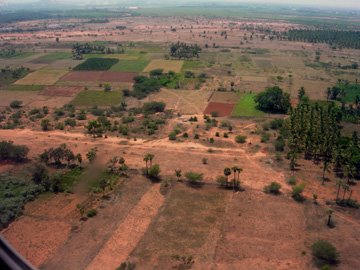
In the morning we flew to Madurai. This is what the land looked like as we descended:


The earth is red, and in many places the vegetation is sparse and scrubby. Rocky hillocks rise abruptly out of flat plain. I have flown over Tamil Nadu and into Kerala before, and each time I have felt the abruptness of the change: Tamil Nadu vast, dry, red -- it has fields, rice paddies, orchards, but they appear to be clinging to the surface of a hard land; then, cross the ghats - the low mountain range which runs up the western side of India - and BAM! Kerala, green, lush, abundant. Both landscapes have their own beauty, but Kerala's is more obvious.

This time we landed in Madurai, a temple city in the south of Tamil Nadu, and drove up the hills and into Kerala. (Here's a map. We started from Chennai, which is shown in blue, right on the northeast coast. Madurai is more than halfway down, more or less in the centre, and situated at a crossroads: a real heartland city. We drove west, through Theni, and just across the border into Kerala.)

Thekkady is 150 km from Madurai. The drive took 3 1/2 hours, most of it through flat plains – rocky outcroppings, fields, plantations of coconut, grapes, sugarcane; many small villages. Village temples, some of them protected by large painted sculptures of warriors on white horses.

In several places farmers had spread out hard cobs of millet on the road, to be threshed by the cars driving over them. Parts of the road were thickly lined with shady trees, their trunks painted in black and white warning stripes.

At one small village, a small procession emerged onto the road: about ten people. One man carried a red umbrella - tall, dome-shaped, intended to symbolise royalty or divinity. Behind him a woman carried two decorated brass pots on her head.

Later we passed another mini-procession in a larger village: a drummer, a couple of men in horse costumes, prancing.

The hills rise directly out of the plain. The ghat road ascends abruptly, much more steeply and directly than on the road to Coonoor. The road is less travelled than the road to Coonoor, which is often like a roller coaster ride, with cars flying in both directions on the same narrow track. A beautiful drive through forest, with views of green hills and valleys.


A few tiny villages are strung alongside the road. At Kumili village one leaves Tamil Nadu and enters Kerala by driving under a bar which extends across the road. This is where the hotels and resorts begin. In five minutes we were in Thekkady.

Thekkady 1

We just got back from two weeks in relatively cool Thekkady, a small town on the Kerala side of the Kerala-Tamil Nadu border (but not by much), which abuts a huge game sanctuary / forest. It is my earnest intention to post some drawings, words, photographs of the same over the next few days.


(This photograph is a cheat, actually, because as you can see, the drawing is different from the real flower's pose. I had drawn it on the tree first, but its face-on view was much more complex and amazing than its profile. So I plucked it and brought it back to our room, and did it again on watercolour paper.) And by the way, what is it? It's gorgeous, with a sheen like silk, and seems to grow wild on the roadside, on trees - or perhaps they're large shrubs... (update: thanks to Anna, who surmises that this is a datura.)

Demolition Day 5


Hotel Oceanic, on Santhome High Road. I've never been closer than this - it stopped being a hotel long ago, though I've been told that it was quite glamorous in its day. Lately it has been used as a location for film-shootings. Recently someone wanted to renovate it and make it into a boutique hotel, but that didn't work out. Now it has fallen to the building boom which is transforming the city.


Part of the arch leading into the hotel grounds, which have been blocked with a chain and padlock ever since I've seen the place. I never had the nerve to jump over the chain and take a look inside.

I had a fantasy, which I named A Weekend at the Oceanic: people in elegant clothes, and this crumbling building in the background. Nadira in a glittering long gown singing 'Mudmudke na dekh' ('Don't look back').

(My [not a masterpiece] painting of the Oceanic, based on these photographs, is here.)

(Update: Nadira, Hindi film star of the fifties, died on 9 February 2006.)

Coonoor VI

I think I'm about done with Coonoor for now, but I wanted to throw in two pictures.

We drove to Tiger Hill, which is supposed to have a great view, but it was full of mist. I took this picture, which makes me very happy:


It's a tea garden. You can see tea bushes below, and silver oaks above. The oaks are spaced out and trimmed so that just the right amount of sunlight reaches the tea plants.

(In this context there was an interesting article in The Hindu recently: Rainforest Revival: "Every year, hectares of rainforest vanish in the Western Ghats, partly the result of expanding plantations. After decades of bad press, a group of estates in Tamil Nadu decide to prove the critics wrong.")


We were waiting in the car for someone, at the bottom of the ramp leading to the hotel, beside the churchyard wall. We always carry R's heavy camera bag, full of lenses, but lately he has rarely taken a photograph. As we sat in the car I handed him my new digital camera, which he had never used. He raised it idly and took this picture - the best of the lot, in my opinion. So irritating... but I love the picture:

Coonoor V

The Nilgiri Mountain Railway, familiarly known as the toy train, travels from Mettupalayam on the plains up to Ooty - a four-hour journey - and back every day. There are several websites with pictures and information about this train, which has just been declared a UNESCO world heritage site - here and here and here and here. One day we picked up the train at Coonoor and rode Ooty, a one-hour trip. My notes aren't very interesting, and my photographs are blurry. It was lovely, though - slow enough so that cows could saunter across the track in front of us without fear -- about 10 kph. A couple of tunnels, many wonderful views. A hoopoe flew across in a flash of black / brown / white.

We had lunch at the Savoy, in Ooty. I browsed through an old book - Ootacamund: A History - while we waited for lunch. I read about the second western 'discovery' of Ooty - the first, brief encounter, was in 1602, but this was the one that led to British settlements in the Nilgiris: in 1818, two English civilians reached Ooty - they might have been pursuing "a poligar who had been misconducting himself... they found the man they were in search of, in a hut. He was exceedingly polite in offering refreshments to the gentlemen, and pretending to go for some milk, took the opportunity of making good his retreat." In pursuing him they discovered the excellent climate, etc.

colonial kitsch: tripods of lances (for pig-sticking?)
hung with pith helmets


After lunch we went to look at a house that was for sale. We have a recurring fantasy about buying a second house here, or even resettling in the hills somewhere - but we haven't been sure enough to go through with it. The house was up a steep driveway - most of the property was steeply sloped and forested. It was charming on the outside; but we peered through the windows and found it very old-fashioned, rudimentary. There was an outbuilding for the caretaker and his family, a garage and, slightly up a hill, a small cottage.

The caretaker's wife, Mageshwari, showed us around. She was tiny, barefooted, slim, with a beautiful face, a sweet smile, very polite - we felt that we could almost buy the house in order to have her work for us. In the end we felt that the house would have to be gutted and modernised, and it seemed too big a project for us to take on. But the next day I felt a little guilty - austerity is good? the house looked cold because it was empty? Mageshwari's delicate bare feet, while I shivered in my sweater.


Morning: Crows squabble on and nibble the grass, a monkey steals a sugar packet from someone's room.


At the gate, the watchman chats with a sweeper in sari and brown sweater. She laughs.

A woman walks by with two bounding dogs.

A goods carrier grinds down the road.

Cloudy, with a very light drizzle.


I've made this guy look cheerful, when actually he's pensive and moth-eaten and sad.

Lunch: a child bangs his spoon on a table. The parents are unconcerned. Finally a waiter goes over and tells the child, "Don't! If you do that, monkeys will come."


This is a cubist goat, because I kept sketching it, even as it moved

The goats like to stroll across the road just as a truck comes barrelling down it, causing the truck to come to a halt. The woman who appears to be the goatherd says to them "Where are you going?" but idly, as if it is a casual conversation.