Several Things

A recent search referral:
plaster crumbling away salt infection

I read this and immediately thought, Yes, that's me all right...


Some good photographs of Chennai.

A new(ish) Indian blog directory.

I love mehndi. Here's a photoset of Indian mehndi on Flickr. And one of Arabic mehndi. (both of these links via Dispatch from L.A.)


A pleasant side-effect of the real estate boom: yesterday afternoon one of the city's few organised real estate brokerage firms sent us a bushel basket full of perfectly ripe banganapalli mangoes. How many such baskets must they have delivered all over the city?

I've eaten more mangoes this year than ever before, and the season is not over. Last night Mary surprised me with a sweet-sour curry of green mangoes from our garden, after I had eaten one of the meltingly sweet real estate-mangoes for tea...

It is equally sweet-sour to remember that mango season will be over soon; though if it weren't I would be in danger of ending up like the young English lady in India whose epitaph I'm sure I read about somewhere, who died of a surfeit of pineapple.

Sheets

In India, when you are talking about bed linen you don't say 'sheets' but 'bedsheets.' I suppose it's to save you from the embarrassment of asking a shopkeeper for sheets and being presented with pieces of paper, or sails.

I struggle with insomnia. Tossing twisting, contorting into the aches I will feel tomorrow, I forget what I am trying to do: SLEEP, dammit.

It's dry, dry, not finding sleep. The twisted sheets have sandpaper edges. The air-conditioner gurgles like a creature with indigestion. I will fold one sheet into a captain's hat, another into a boat, raise the sail and I'm away.

Two Searches

I don't look at my search engine referrers very often - they tend to be pretty repetitive (e.g., from a few minutes ago: 'late in night we clothless photo') - but yesterday I did, and I found two interesting ones:

--'at what does watermelon laugh when it's murdered.' That was intriguing enough that I did the search myself, and found this page. I'm not sure exactly what it is, but I gathered that it was a line from a poem by Pablo Neruda, and, searching further, found this.

--'I chopped down the house that you had been saving to live in next summer'. That turned out to be from 'Variations on a Theme by William Carlos Williams' by Kenneth Koch. Here it is, from this site:

Variations on a Theme by William Carlos Williams


1
I chopped down the house that you had been saving to live in next summer.
I am sorry, but it was morning, and I had nothing to do
and its wooden beams were so inviting.

2
We laughed at the hollyhocks together
and then I sprayed them with lye.
Forgive me. I simply do not know what I am doing.

3
I gave away the money that you had been saving to live on for the
next ten years.
The man who asked for it was shabby
and the firm March wind on the porch was so juicy and cold.

4
Last evening we went dancing and I broke your leg.
Forgive me. I was clumsy and
I wanted you here in the wards, where I am the doctor!

-- Kenneth Koch

That's two excellent discoveries. I must read my referrers more often.

Mango Thieves

Six large mangoes were stripped from our tree overnight!! And I have a prime suspect, too... but I only used that post-title because it sounded so good: what I really want to talk about is saffron.

When I became a poor imitation of a Gujarati housewife, one of my first tasks was to phone in the monthly provisions order, something which my mother-in-law had been doing before my arrival. The provision store owners were also Gujaratis, so they had all the special things we need, like kokum, methi kuria and so on. Once a month their van would pull up, and the kitchen floor would be heaped with bags of rice, dals, oil, sugar, spices and so on. It was a big event. Now we have stores which somewhat resemble American supermarkets, and I prefer to go and buy the stuff myself; but they did not exist at that time.

So I carefully made a list and phoned the store. They always recognised my voice, and put me on to the best English speaker among them. I began working my way down the list. We ordered most spices in 100 gm. packets – cumin, anise and black mustard seeds, turmeric powder, asafoetida, etc. On that particular day, I also had saffron on my list. We didn’t use it very often, but it had run out. So, along with everything else I said, “Saffron, 100 gm.” There was a silence on the other end of the line, and the man who was taking my order said, “Sister, do you know what 100 gm. of saffron costs?” I didn’t, and he named an astronomical sum. It was my turn to be silent, then I said very meekly, “So, how much do you think I should order?” He said, “One gram should be fine,” and I quickly agreed.

I remembered this in the grocery store yesterday, because another foreigner was similarly taken by surprise – she was confronted with 4 or 5 grams for Rs. 315 (about US$7). I’ve been grinning ever since.

(update: I've gotten some good comments on this post:
Ravi said, "I encountered a similar case in a grocery store in Chennai many years back; but the ingredient then was cardamom. I think the customer lady ordered for about 100 gms and the guy in the grocery store immediately quipped 'Are you having a wedding at home?'"

Kumar said, "... I was sent by mother to get 1Kg milagai (red chillies) for avakai from our mango trees. I shortened it to "milagu" (pepper), ... I was laughed off and asked to check with my mother again."

Subramanian said, "Immediately on introduction of metric sytems ... I had been to a nearby grocery and I ordered 5 grams of Butter without any idea how much it would be. Then the grocery man ... said he is not even having such an accurate balance to weigh 5 grams ..."

It seems that looking silly at the grocery store is a common experience.)

Ba on the Ganges

This week's Poetry Thursday prompt is rivers. This is the last in a series of poems I wrote after my mother-in-law died.

Ba on the Ganges

When Ba was heavy and middle-aged,
she took her mother to Benares.
They sat side-by-side in a small boat,
posed stiffly for a photograph.
Behind them, temples, and stairs to the water.
Both faced the camera, smiling slightly,
together holding a small brass pot.
They poured a thin stream of milk into Ganga.
You are Himalaya's daughter.
You came from Heaven to purify the world.
You flow from Shiva's tangled hair.

One of the things set out in her bedroom,
with gods, liniments, spectacles, prayer-books,
was a small copper cauldron, sealed with tin --
Ganga water, last aid, to be poured into her mouth
as she was dying.
You purify those who bathe in you.
You contain the hopes of men for salvation.
You bear the burden of the dead.

When the family women reached the hospital,
each carried Ganga in her purse,
but Ba’s nostrils were already stuffed with cotton,
jaws tied with a strip of white cloth.
They poured the water over her lips.
Your waters bear half-burned corpses.
You enter into them.
Your bed is heaped with bones.

Ba’s brother took her ashes to Benares
in a clay pot garlanded with marigolds.
Bending over the wavelets which slapped against his feet,
he set her afloat on Ganga. She bobbed on the surface
for a minute or two, then sank to join
the assemblage of the dead,
given to the mercy of the river.

Other poems in the same series: Journeying, Uses for Wood, Sorting Ba's Things

Pattern


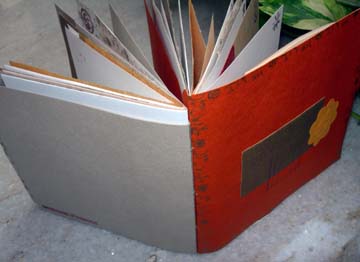
I've been making books lately, using a good new book-making book. These two have covers made of cut-down photographs by R. The photograph, called Pattern (the link is to the complete photograph), was silk-screened on handmade paper. He also wrote a poem called Pattern, which was exhibited alongside the photograph:
A PATTERN IS
EVEN IF
ASSYMETRICAL
INTRINSICALLY
AN ORDER
IN CHAOS

LIKE A VAGABOND
BREEZE
PLAYING UPON
THE RESPONSIVE
STRINGS OF A
CARESS-HUNGRY LEAF
TO EXPLODE
INTO RAPTUROUS FRAGMENTS OF AN
UNFORGETTABLE
SYMPHONY
India Without the Slogans - the back page essay in the latest Time magazine's Asia edition. A well-stated reaction to some of the hyperbole surrounding India at the moment. I love India and I hope its future is the brightest -- but it has a long way to go before it overcomes its enormous problems.

Boom

Chennai is in the grip of a real estate frenzy. Last week I accompanied a friend who is looking for an apartment, to try to get an idea what all the fuss is about.

We first went to a project in Alwarpet which is just a couple of months from completion: 5 buildings set close together, with an open area in the middle, which will eventually contain a swimming pool. All but two of the flats have already been sold. We walked through one of them and saw from every window the nearby windows and balconies of the neighbours. The person who had taken us to see the project said that it had opened for advanced sale two years ago, at Rs. 2,500 per square foot. The remaining flats have been selling for Rs. 10,000 a square foot -- what an increase, in only two years! The flats that we saw were decent, but small and not exceptional.

Next we saw two empty plots in Poes Garden, one of the city's hot real estate spots, where the price was Rs. 12,000 per square foot. Again, all but one of the flats had already been sold. Then on to Rutland Gate, where a project is going for Rs. 11,000 per square foot. At least there, there is a private lift for every flat, as well as a swimming pool, and there are only 15 flats on 21 grounds -- less density than what we had seen so far. All but three of the flats have been sold.

Finally we went to the Boat Club area, which is considered the ultimate in snob value. It was once full of enormous houses, and it's still quiet and leafy. But I was surprised at how many apartment buildings had come up here, too. We saw a flat that was slightly under 4,000 square feet, which was selling for Rs. 17,000 a square foot! That's about 7 crores for an apartment (= approx. US$1.5 million, if my calculation is correct). Once again, it was spacious, which most Indian flats are not; but otherwise not obviously special.

I went home with my head swimming, and blessed our green garden, and our own house, with its own peculiarities, faults and virtues. It felt like a small island in a choppy sea; but the city is changing so rapidly all around us: I wonder how long we will be able to withstand it.

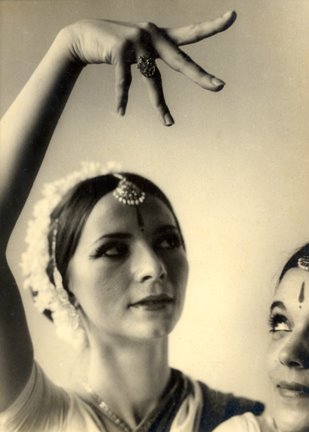
Getting Ready

Kathakali dancer getting into costume, Madras, 1978

Pluperfect

The Poetry Thursday prompt this week is for a humorous poem, or a poem which tells a joke.

NOTE 1: The poem starts off with one of my favourite jokes ever. No one to whom I have told it has ever thought that it was funny.

NOTE 2: Scrod is a fish which is associated with New England.

Pluperfect

This guy is visiting Boston for the first time.
He gets into a taxi and says to the driver,
“Do you know where I can get scrod?”
The driver says, “I’ve heard that question a million times,
but never in the pluperfect subjunctive.”

Taxi drivers are the Buddha.
Bartenders are the Buddha.

The meaning is, "Hey, buddy,
why are you tying yourself in knots
over something so
subject-verb-object
as conjugation, anyway?
Do I have to draw you a diagram?"

The man in the back seat realises
that pluperfect is too much to ask
and achieves nirvana.
He leaves without giving a tip.

Breath

The heat is so great now -- 105 or 106 F every day -- that whenever I open a drawer, hot air pours from it, like the breath of something living.


I went out for some errands, and found a small patch of shade in which to park. The nearest house had a small marble plaque on the gatepost with the name of the house: Surya Kripa ('the sun's benevolence'). Talk about putting the best face on things.

Bulldozer

I've been fooling around with Photoshop. I had a photograph of a bulldozer road roller which I had taken in Coonoor a couple of years ago. When I found an online tutorial on how to make your pictures look as if they were taken with a Lomo camera, I tried it out:


I was attracted to this bulldozer road roller the moment I saw it, but it's only now that I feel I have been able to do it justice.

Doodh

Some time back I wrote a post about a great TV ad from 1996, which I remembered very fondly. It urged people to drink milk. I had copied the lyrics from the TV -- they were innovative at the time, a clever mix of Hindi and English that wasn't quite so common in those days. The singer of the jingle, I learned recently, was Kunal Ganjawala, who is now a successful playback singer.

At the time I couldn't post the song itself, but that was before YouTube. Here it is -- an abbreviated version, unfortunately, but watching it still brought a smile to my face.

Sweet

When I hear the Tamil word for honey - then (rhymes with lane) – it feels very old, because it's a one-syllable word in a polysyllabic language. A bee is theni. Yesterday I learned that the word for beehive is then-koodu. Both Lakshmi and Mary were excited -- they approached me separately saying, Do you know there's a then-koodu in the garden?

Mary says that the honey will be most abundant by amavasi (the new moon) which is coming on May 16. After that the bees will drink it away, and the hive will dry up. R eats honey in his oatmeal, so they were trying to figure out how to get the honey for the household.

I went out with Lakshmi to see it. She pointed, but it took me a long time: I was looking for something like the cartoon hive which is swung at by a dim-witted bear, and which bounces back in his face like a punching bag, full of angry bees. But this was formed around a branch, very high in a eucalyptus tree. It was more than 2 feet long, and black, like a thickened growth on the tree itself. I felt it as a kind of natural blessing, and saw with relief that it would be very tough to get all the way up there. I said, "Let it be; we don't need that honey."


Now I am making a transition, from the Tamil word for honey to the Sanskrit word, madh; and on to its relative, the old English word for honey-based liquor, mead; and finally, over to an article in yesterday’s paper. The article says that our state of Tamil Nadu will soon sell imported liquor through the state-owned liquor stores, as part of compliance with WTO requirements. I am hoping that at the same time Indian wines will become available here too. It would be ironic if I could legally drink imported wine, but not the local stuff. And that in itself could be a good enough reason not to change – we need our ironies, after all.


One more transition, to another kind of sweetness: yesterday Ethiraj, the gardener, climbed up the big mango tree with a cloth bag tied to a long rope. He picked the fruit and lowered it in the bag, where the watchman waited to empty it, with Lakshmi on hand to call out advice, above and below. Now we have 100 mangoes, in addition to the 90 from the first picking. This year they really are good and sweet, better than ever before; and plenty for everyone.

Poems of Summer

from Sanskrit Poetry from Vidyakara's "Treasury", translated by Daniel H. H. Ingalls

199
Above the fledgling of the wild goose,
although he rests in coolness of a flowering water-lotus,
the loving mother bird will hold her wings,
a handsome white umbrella.
The little parrot, parched with thirst,
resting on a fair maid's bosom,
will sip at the necklace pearls which grace her breasts
in hope that they are water.

201
Coolness, which stayed a while beneath the waters,
made brief acquaintance with unguent of sandalwood,
set foot on lily stems and moonlight,
and rested later in the shade of tasty plantains,
now is found alone
within my sweetheart's arms.

214
The summer breaks the tight embrace
of God Narayana and Goddess Sri
already sleepy from the ocean's rocking
of their water-dripping palace.
And now the sun's fierce rays
do fry the moon, deprived of all its spendor,
as if it were a pancake
on the heated potsherd of the sky.

Two Links and One Home News Flash

Links first:
From the Washington Post: Finally, Our Chance To Savor India's Favored Fruit ... "This is mango's moment. For the first time, India, the world's largest producer of the world's favorite fruit, has been granted access to the U.S. market. Best of all, it's the particularly coveted Alphonso variety that is on its way to grocers...."

From The New Yorker: Letter from Jaipur - The Idol Thief: Inside one of the biggest antiquities-smuggling rings in history.

Home news:

Our gardener cut his foot on the iron lid of the underground water tank, and it became infected. He walked gingerly, and wore a cloth wrapped around his foot for several days - he works barefooted. But then he removed it, so I assumed that he had recovered.

Three days ago he didn't come to work. In the afternoon his wife called and said that the infection had not gone away, and that he had been going to the hospital every day for an injection. According to her, the injections had generated too much heat in his body, so he had been eating only gruel and yoghurt (cooling foods). Finally, the diet and the foot together had kept him from getting out of bed altogether.

(I am writing about it because of the Indian notion of heat and coolness in the body which, when out of balance, leads to illness. Each new instance of this idea fascinates me.) (Fortunately, because or in spite of his mix of western and local treatments, the gardener has now recovered.)

How We Cope With the Heat


After Lunch (Mahabalipuram)
photograph by Ramesh Gandhi

South Indian Spiders

You know those light brown spiders whose legs grow to about the circumference of a saucer, and who, because they like moisture, lurk in bathrooms, so that at your most vulnerable moments you may look up and see them and get all mentally disorganised? I assume that they're harmless because no one has ever warned me against them. And I don't mind smaller spiders at all, probably because I loved Charlotte's Web... but I do wonder sometimes.

So I found this very interesting website, South Indian spiders. It's attractive to look at, with photographs and descriptions and lots of information about spiders generally (and some slightly creepy or cute graphics, depending on your point of view).

Unfortunately I can't figure out whether one of them is the bathroom spider -- which I have seen in other parts of India as well. Can anyone enlighten me on this one?

The Kiss

The New York Times has a piece that takes off from the infamous kisses which Richard Gere bestowed on the cheek of Shilpa Shetty on stage in India recently -- kisses which led to both of their effigies being burnt in demonstrations by Hindu fundamentalists (although it's clear from the video that Shetty is trying politely to avoid his intentions; at the end she said in Hindi, "This is a bit too much." I know this because we have been forced to watch the same clip again and again for days on the TV news.).

According to the article,
The earliest written record of humans’ kissing appears in Vedic Sanskrit texts — in India — from around 1500 B.C., where certain passages refer to lovers “setting mouth to mouth”

And it describes the Romans' classification of different kisses:
the “basium,” for the standard romantic kiss; the “osculum,” for the friendship kiss; and the “savium,” the most passionate kind, sometimes referred to as a French kiss.

What would we do without such grave issues to ponder?

Luxury Rooms Still Available


Once again we went for coffee, and looked at the LUXURY ROOMS AVAILABLE sign that I had blogged about here. I pointed the sign out to R as if it were a famous or beloved landmark, and as I did so I saw that one of the rooms had an occupant. A man wearing a sleeveless undershirt was leaning on the sill of an open window, smoking a cigarette and looking out. He was just as I had imagined him, except that he wore trousers instead of a lungi – but then it was the middle of the day. (Perhaps he was one of the guests Teju suggested in a comment to my earlier post, who required a luxury room only for an hour or two.)

On the way home I stopped at a stationery store. While the proprietor was writing out my bill a man came in and bought three sheets of paper. He handed over a ten-rupee note, but the proprietor shook his head and said, “No change.” The man fished around in his pocket and came up with a Rs. 5 coin, whereupon the proprietor grudgingly opened a small drawer full of coins, and gave him Rs. 3 back.

Thus the highlights of the day.

The Fire Star


Agni Nakshatram ("Fire Star"), an astrological period after which this blog was named, is traditionally the hottest period of the year. It began on May 4, and continues until May 29.

We've been suffering fiery weather for several weeks already this year -- whether it's because of global warming or not, when you live in the tropics even a slight rise in temperature affects you immediately. I'm too enervated even to describe it.

On the plus side, mango season has begun. We have two mango trees, of two different varieties, in our garden. The mangoes from the larger tree -- the gardener goes up to the roof-terrace to pick them -- were harvested last week when still green, and put away in a dark place to ripen. The ones in the photograph are not quite ready yet. Our mangoes are never very good, but I always watch with pleasure their progress from sprays of tiny white flowers to green buds to full-grown fruit. (And then I go to the store and buy a box of Alphonse mangoes from Maharashtra.)

In the Dream

Poetry Thursday inspired me again:

In the Dream

You bent over me smiling
I in my white cotton dress
(though really you were someone else).

Then

a woman
splayed into an X
for DANGER for NO
fell
endlessly slowly
into a giant sinkhole.

It is about the past
and the message is
KEEP BACK FROM THE EDGE.

I didn't need to be told so much
just because I found
crumpled
brown-spotted
behind something
a page of calligraphy:

Urdu loops and curves
woven into a poem
spooling backward.

love is an ocean of fire ||
in which you must drown ||

Chatrabuj Gandhi


I made this pen-and-wash painting of R's great-grandfather and two of his descendants, from the photograph I had posted below. I have inadvertently improved his looks: in the photograph he is, to be truthful, rather piggy-faced.

Family Photograph


I came across this photograph yesterday (click for a larger view). The elderly man in the centre, wearing a white turban, is R's great-grandfather, Chatrabuj Gandhi. R is not sure about the rest, but one of the young men standing behind him must be R's grandfather Dwarkadas; Dwarkadas's oldest son, Mangaldas, R's father, is probably one of the small boys.

It doesn't matter if none of these people are actually in the photograph -- they could all be complete strangers. What I thought when I studied their faces was that these people, like us, were all starring in their own internal stories, even as they sat for the photographer; I imagine that they were all convinced that they were exceptional and significant in the universe. And of course, for all intents and purposes they have all vanished without leaving much of a trace: a faded photograph, some DNA, maybe a house one or two of them built, which still stands in the village.

I know all this, and yet part of me is still convinced most of the time that I'm the star of the play, and that I will never die.

(Actually, the very first thing I thought was about styles of headgear: the elders are wearing turbans; the younger generation, round caps. In more recent pictures of R's father and uncles, they are all wearing white caps shaped roughly like an upturned canoe; and the younger generations have abandoned headwear altogether. And -- oh yes -- where are the women? They didn't observe purdah, and the girl children are included. Were they standing to the side, observing the occasion, or preparing the after-photograph lunch? I bet they were all starring in their own stories nonetheless.)

Luxury Rooms Available


We discovered another coffee place today -- Coffee World on LB Road, next to the flyover, in Adyar. It is pleasant, but its gigantic windows look out on an ugly view.

I did have a chance to speculate on who the occupants of the luxury rooms might be; travelling salesmen of small items, perhaps, carrying samples in worn molded-plastic briefcases, perspiring in the summer heat. The small reception area would contain one man dozing or reading the newspaper under a dirty ceiling fan, and perhaps a small boy, ready to run errands or bring cold drinks - served in the bottle, with a straw. At the end of the day the guests would return from meetings, bathe from a bucket of cool water, change out of shirts and trousers into more relaxed lungi and undershirt, and lie down for a while, before deciding what to do with the evening.

Postcard Vendor, Golconda


Photograph by Ramesh Gandhi


We recently came back from spending a week in Hyderabad. We hardly got out, but did manage to see Golconda Fort and the Qutb Shahi tombs. I had seen the fort many years ago, and had a vague image in my mind of a vast expanse of strewn boulders and cut stones -- but it wasn't like that; it's a ruined but still beautiful hill fort, one of many in India. Golconda was fabulously wealthy, in large part because it is said to have been the ancient world's only known source of diamonds (including the Kohinoor and the Hope diamonds). Here's the wikipedia entry on Golconda, which includes a list of other Indian forts.

As we walked out of the gateway this man approached me with his envelopes of postcards in the crook of his arm. I was holding my camera; I gestured with it and said, "See, I have my camera. I've taken so many pictures, I don't need any postcards." He replied very mildly, "But you may not have these angles; just take a look." By this time R and our friend had emerged. I asked R if he would take the man's photograph. R said, "She would like to take your picture, is that all right?" He said politely, "If Sahib will stand beside me." But he stood against a wall of the fort, and R composed it so beautifully, with the angles of the envelopes and the (modern) stairs. And we bought two sets of photographs, and parted cordially.


Here are some photographs which I took of Golconda, at Flickr.

Blogday and stuff


under the fire star was four years old yesterday. Appropriately, I missed it....

Just to mention a couple of other blogs I've encountered recently:

Parayil A. Tharakan Blog may not have the most catchy name, but it's worth looking at. It is full of stories and pictures from a Kerala which must largely exist only in memory.

I just came across this one today: India outside my window -- another expatriate, in the not-far-away Southern city of Bangalore.

Abida


Abida Parveen, a Sufi singer from Pakistan, has a big, powerful voice. Because of this voice, and the passion with which she sings, and also because of her remarkable (big, powerful) physical presence, she has become instantly recognisable in India and Pakistan. Sometimes I find her overwhelming, as I did another singer in the same tradition, the late Nusrat Fateh Ali Khan. But recently a friend gave us a CD of Abida Parveen singing songs of Hazrat Shah Hussain, which are more melodious than some of the work in this genre. I quickly became hooked to one of them, Raanjhan. I've been listening to it every day, and every day it has the same mesmerizing effect on me.

I've uploaded it as an MP3 here. I'll keep it up for a week or so. It's a big file -- 10.9 MB -- so if you don't have a fast connection you can listen to a streaming version of it at musicindiaonline.com. If you like it, you can hear the rest of the CD at the same site here. Do listen to it, and tell me how you reacted to it.

I found an article in the Pakistani newspaper Jang about the annual festival at Shah Hussain's tomb in Lahore. It's vividly written, and includes information about Shah Hussain (1538-1599), who must have been quite a character.

Hitchhiker

I recently finished reading Vinod Joseph's first novel, Hitchhiker, published by Books for Change, Bangalore. Its protagonist is Ebenezer, a young man from a family of Dalits (once known as Untouchables) who have converted to Christianity in the hope of shedding the stigma of their low caste. He wants to get an education that will enable him to leave behind the suffocation of lowest social status in a small town. The novel sees him through a series of trials (including re-conversion to Hinduism) which leave his future very uncertain.

I stuck with this book in spite of the depressing course of Ebenezer's life because the book appeared to be such an accurate reflection of life in a village in Tamil Nadu, far from the big city where I live; and of the outside world at the time that the action is going on. It's full of tiny details about the local church, the way people eat, the things they must do to try to get ahead. I felt the heat, the sweat on my forehead, smelled the food and its oil on my fingers at these points in the story.

The book talks (at too much cost to the flow of the story, I'm afraid) about caste politics in Tamil Nadu, about the IT sector, about high caste violence against low caste. I found much of it to be told as if from a distance -- a scene of rape, for example, seemed narrated as if it were obligatory, without getting me into the head of the victims. In the end I read the book as a document of a part of life here of which I've heard, but with which I have had no direct contact.

I think the author will be able to expand and grow as a storyteller when he less less of a social burden to carry; but this book can be read as what seems to me to be an accurate picture of a particular life which could hardly be farther away from those of most of its readers.

There's an interview with Joseph on The Great Indian Mutiny.

A Prison Evening

I was looking for a transliteration of an Urdu poem by Faiz Ahmed Faiz, and found it; but then I found this also, and it was amazingly beautiful -- from The Wondering Minstrels :

A Prison Evening

Each star a rung,
night comes down the spiral
staircase of the evening.
The breeze passes by so very close
as if someone just happened to speak of love.
In the courtyard,
the trees are absorbed refugees
embroidering maps of return on the sky.
On the roof,
the moon - lovingly, generously -
is turning the stars
into a dust of sheen.
From every corner, dark-green shadows,
in ripples, come towards me.

At any moment they may break over me,
like the waves of pain each time I remember
this separation from my lover.

This thought keeps consoling me:
though tyrants may command that lamps be smashed
in rooms where lovers are destined to meet,
they cannot snuff out the moon, so today,
nor tomorrow, no tyranny will succeed,
no poison of torture make me bitter,
if just one evening in prison
can be so strangely sweet,
if just one moment anywhere on this earth.


-- Faiz Ahmed Faiz (translated from Urdu by Agha Shahid Ali)


(The beauty and clarity of this translation became even more apparent when I compared it to the one by Shiv K. Kumar in my copy of Selected Poems of Faiz Ahmed Faiz, which begins: "From the sinuous pathways of evening stars / the night climbs down, step by step...")

Read about Faiz (1911-1984) in the Wikipedia.

In Mahabalipuram


The sand under our feet - me and my friend P - as we walked toward the shore temple. Fishing boats drawn up on the beach. One or two traditional silver-grey catamarans, trunks of worn wood lashed together; the rest modern boats; some with the names of relief agencies on the sides, given after the tsunami. The tide was coming in, it kept washing up to my knees. We would move higher up, then come down to feel the water swirling around our feet. Then it would rise up again, and we would move back, so that we seemed to be staggering drunkenly, laughing. The way people customarily walk on a beach, in fact.

At lunch: A lobster was on display, along with a grouper, a snapper and a hoomoor (?), laid out on small round white stones. The lobster was beautiful; ornately stippled, striped and decorated, dark brownish/greenish, a baroque jeweller's decoration for a wealthy dining table.

The red snapper was more bony than I had expected, its flesh came away in soft flakes. A wafer of chocolate mint afterward, wrapped in gold foil and encased in a hexagonal black paper box. Sula white wine.

Afterwards we lay in string hammocks tied to palm trees. I photographed my feet crossed on the tapering end of netted cotton rope, the long fronded leaves spreading above me. The breeze was strong enough to sway me from side to side, and I found myself humming Rockaby Baby, not part of my usual repertoire.

It was one of those precious days, on the cusp between cool and hot seasons, between land and sea, time out from ordinary time.

A Saffron Umbrella

I was feeling aimless, discontented. I was babbling. I said, "I need a designer. I need a personal trainer. I need a guru. I need Sai Baba and his saffron umbrella." He was in town yesterday, we had driven by chance past a place where he was walking among a group of gawkers and devotees, blocking traffic and crowding around him so that we could see nothing but the slowly-moving top of his umbrella.

R said, "You don't need Sai Baba - all you need is a saffron umbrella. It would shade you from the sun, and you would be fine." We laughed at the absurd image, and I felt much better.
[my remarks] "out of proportion blow kiya hai"

Hema Malini said this, trying damage control after saying that North Indians who have a hard time in Mumbai should go back where they came from. I posted it because it's a wonderful example of Hindi-English. At the same time, my mouth really fell open when she made the first statment; some years back, South Indians, of which she is one, had a very hard time in Mumbai, thanks to anti-outsider campaigns by the Shiv Sena political party. I want to say 'what was she thinking?' but I think I already know the answer: nothing at all.

Christmas Eve and MGR

Here's something different: an MGR fan-blog. MGR, an extremely popular filmstar and then politician, died on Christmas Eve, 1987. I found this passage from the blog especially interesing:
[someone said that] when MGR fell sick in 1984, he was rushed to Brooklyn Hospital in United States. There he died, but he was fitted with machines and the control was given to MGR's wife Mrs.Janaki Ramachandran, and she controlled, the button is not mechanical one it is in a form of medicine (tablets).

...

One day (23.12.1987 night) MGR's wife has administered the wrong drug and the machine ceased to function and it was reported that MGR was dead.
...

As it happens, I was working at the American Consulate in Chennai when MGR died. I've posted my memories of that time on Chennai Metroblogging. Here's the text: M. G. Ramachandran, known as MGR, died on Christmas Eve, 1987. He had been an extremely popular filmstar, and then politician; he was Chief Minister of Tamil Nadu when he died. He was elderly and his health had been failing for some time, but his death caused an enormous outpouring of emotion in Tamil Nadu. I was working at the American Consulate in Chennai at that time. Early in the morning on Christmas Eve, the Consul General (CG) called me and said that he had heard that MGR had died. He said that I should try to get in to the office as soon as possible, because we were afraid that there might be some kind of unrest in the city. I was able to drive in from my house in Rutland Gate because it was still early. Later, as more people heard the news, people in cars were driven back; cyclists were forced to get down and walk, as a sign of ‘respect.’ As it happened, I had the Consulate building almost to myself. A few people had come walking, or had arrived very early; the rest stayed home. My office was on a level with the Gemini flyover – at the time the only flyover (overpass) in Chennai, and a central route to Rajaji Hall, where MGR’s body was taken to lie in state. As the day progressed, more and more people began crossing the flyover on foot, walking downtown. Soon they were a solid mass; people were coming in to Chennai from outlying towns and villages, to see MGR. I spent much of the day taking phone calls and just staring at the people streaming by. Some of them were crying, no doubt, but as the crowd grew and grew there was and air of excitement, as though they felt their own strength, and wondered what would happen next. Every once in awhile, someone would stop and throw a stone at the Consulate. One hit one of my office windows, and left a spider web of cracks in the bullet-proof glass. In the afternoon, someone jumped over the wall – which had just been raised in a security upgrade, though it had not yet become the fortress that it is today – and smashed the glass on each side of the Consulate’s main door. Then he ran back and over the wall and was gone. There was some looting of shops – I could see from my window a petrol bunk being broken into, and people making off with cans of engine oil and such; some cars, I heard later, were damaged; there was violence throughout the state, and many people committed suicide; but what I saw was just the huge, unimaginable mass of people, all headed in one direction. On the day of MGR’s funeral, I drove out with a black dupatta tied to my windshield wiper as a sign of mourning, and picked up a large floral wreath. I was nervous about it, but no one stopped me. I went to the CG’s house, where a police escort was supposed to take us to Rajaji Hall. No one turned up, however, so we decided to go alone. We put the wreath prominently in the front seat beside the driver, and set off on our own down the beach road. The road was completely jammed. The size of the crowd was unimaginable – hundreds of thousands of people. The driver had to inch along. People peered in, saw us foreigners and the wreath, and parted to let us pass. None of us spoke a word – it was like driving through a tunnel made of living human beings, of whose intentions we were unsure. Eventually we reached the place, later than we had intended, because of the non-existent police escort. By this time MGR’s body had already been removed and placed on a gun-carriage (I think that’s what it was), where he would be taken in procession through the streets, before being buried in a hastily constructed tomb on the beach. We carried the wreath to the carriage, handed it up to someone who placed it on MGR’s body, and stepped back. Then we drove back through those thousands of people; I went home and watched the rest of it on television. If you have seen Mani Ratnam’s film Iruvar, which tells a story based in part on MGR’s life, there is a scene at the end, where the main character’s body is taken on a carriage through huge crowds. That scene looked very real: it brought the day back to me. It was an unforgettable experience.

Flying

We flew from Chennai to Coimbatore. Most of Tamil Nadu is red and flat; then giant rocks or very small mountains rise suddenly from the plains. This view from the plane window, of rocky hills above thin cloud looked like the mountains of heaven:


The main road to Coonoor was closed for more than a month: landslides because of heavy rains. It had just re-opened the day before we drove up, but no heavy vehicles were allowed, since roadwork was still going on. The road was almost empty. In many places, raw red earth slides looked as if it would take very little to set them moving again.

A picture from the hotel:


More of my photos of Coonoor on Flickr
. (and still more to come)
burnblue.com sketchbook:
From November 15, 2004 to June 8, 2005 I travelled through many countries, read 34 books, got sick 3 times, got robbed 2 times, and learned more about myself and this world than i thought possible. This sketchbook records those 7 months in images.

Sketches of Thailand, India, Africa, Europe. Most of it could be anywhere, but I kind of like the idea of a travel sketchbook that doesn't have anything picturesque about it. Once in a while.

Heatiness

My brother-in-law sent us an email, purporting to have been written by a doctor in Mumbai - one of those emails which gets forwarded from one person to another - and claiming that the juice of papaya leaves is helpful in treating dengue fever. Whether it's true or not, here is the rationale:
It's believed one's body would be overheated when one is down with dengue and that also caused the patient to have fever. Papaya juice has cooling effect. Thus, it helps to reduce the heatiness in one's body, thus the fever will go away. I found that it's also good when one is having sore throat or suffering from heatiness.

I've always been interested in traditional Indian medicine's idea that some things are heating, and some cooling, and that an imbalance between the two causes illness. For instance, mangoes are hot. If you gorge on mangoes and get diarrhoea, it is because you have overheated your system. Some foods are obvious: chillies, onions, garlic are hot, yoghurt is cooling. Others, like the mangoes, are not so obvious, at least to me.

I never knew what to call the condition of heat overload, and now I do: 'heatiness.' I think this is a great word, with many applications. In this fast-paced world of ours, there is altogether too much heatiness; and papaya leaf juice, yoghurt or any other cooling substance is certainly worth trying, to get the temperature down.

A Day of Death

It’s All Soul’s Day today – for Roman Catholics, at least; not for my cook, Mary, who’s evangelical. I drove past the Quibble Island Cemetery today (which was an island in the Adyar river delta once, but is so no more, thanks to all the development in recent years) and saw that the gates had been thrown open, and that flower vendors had lined up on either side, selling garlands of yellow marigolds. A steady stream of people walked through the gate, garlands in hand, to visit their dead. A loudspeaker is blaring out hymns.


When it rains heavily in Chennai, as it did last week, and the soil becomes soft and loose with water, big roadside trees topple over. In our own garden, three eucalyptus trees – twenty years old and at least 55 feet tall - began to lean over our neighbour’s wall, breaking it in one place and threatening to crash down on their roof.

Today we brought seven men in to cut the trees down. We feel terrible about it; R and I both cried when the first tree fell. (Mary was practical: she said, "Such big, thick trees -- we'll get good money for them.")

The men worked so hard all day long – small men all muscle and bone, wearing tucked up plaid lungis, shirtless, barefooted; and with only a long rope, a two-man handsaw and some machetes for equipment. In between feeling unhappy and worrying about whether the job could be done with no damage to the neighbour’s property or ours (ten clay tiles smashed on our side, and a number of smaller plants and branches of remaining trees crushed and broken), I was full of admiration for their industry and skill. But it feels like a day of death, all right.

NaNoWriMo 2006

Getting ready for NaNoWriMo, I have gleaned a couple of references to free programs / gizmos for writers. There are lots more, which you can find by browsing the Nanowrimo forums. Go and sign up -- the time to write your novel has come!
Papel - 'the intuitive tool for creative writers'. I just started to use it, and it's wonderful. I've made one 'papel' for my novel, and another one as a kind of idea dump - for blog, poetry, short story ideas. It has a desktop with text documents which can be moved around, as in mind-mapping - for scenes, characters, notes, or whatever you want.

A cute pocket storyboarder.

Noisy Keyboard makes your keyboard sound like an electric typewriter. Turn it on or off, according to your mood.

As to my novel, I've decided to have fun, and not to worry about being intelligent, or about who might read over my shoulder and sneer at me. Maybe I'll actually finish this year.

Lightning

A terrific thunderstorm last night. I saw a bright flash, as if a light bulb had exploded, and glass flying and clinking on the floor. A window had blown out. I photographed it as if I were a reporter at a crime scene, and tried to sweep up the shards. (In the morning Lakshmi found more, 15 feet from the window.)

I looked out the door where the watchman was sheltering in the porch, and said, "What was that?" He said, "Minnal" - lightning. "Is that so?" I nodded, and went back inside.

Still Here

I’ve been so down about the image-less state of this blog – and by extension, the fragility and futility of the world, etc. etc., that I was on the verge of chucking it. The blog, that is. Then R persuaded me not to.

I was driving through driving rain today: it’s been going on for several days now; parts of the city are flooded, and everything is a soggy mess. I was listening to Ernst Bacon’s Remembering Ansel Adams, for clarinet and orchestra, and it became apparent that the inside and outside of the car occupied parallel but completely different universes. It was a dangerous illusion, given the need of the driver (me) to pay close attention to the splashings and swervings; but so pleasant, being cocooned in cool and meditative sound.

Beyond that, life goes on in its usual soggy and messy way. We saw a very good film, Indian but mostly in English: Being Cyrus, with a good cast, and excellent acting by Saif Ali Khan. Divali, the festival of lights, came and went, with some squibs dampened by rain, but enough remaining to create a continuous wall of noise from morning to night. Oh, and I painted a shell that I like. That’s about it.


My husband's take on the same shell.

Coconuts and Poochis 2

Back in March I wrote about how we had applied a medicinal poultice to the crowns of our three coconut trees, because insects were spoiling the young coconuts. And whether because of our efforts or not, the next crop was superior. Now our newish gardener has declared that the coconuts need another dose. He's from the countryside and knows farming - certainly our garden has never looked better - so we have obeyed. In addition to what we had applied in March: rock salt, mothballs, sambrani (a kind of incense), turmeric, and edible camphor (used here in some sweets), we have now added asafoetida and a fragrant bark called (I think) vaasambu. Lakshmi, Ethiraj the gardener, and a coconut-tree climber worked to pound the ingredients between two stones in the ugliest part of our house, the area behind the kitchen:


The coconut-tree climber has an interesting looking container hanging from his belt to hold his machete. the rope over his shoulder is his climbing sling. He wrapped the pink cloth around his head to make an informal turban, shinnied up the trees, cut off excess leaves (how does one determine this, I wonder?), cleaned the crowns, applied the poultice and shinnied back down again. Now let's see.

Two French students by Ramesh Gandhi

An Elephant Crackup


There's a fascinating / scary / terribly sad article in today's New York Times magazine: An Elephant Crackup? It is primarily about African elephants, but it mentions Indian elephants as well; and the problems are apparently evident among all elephant populations:
... today’s elephant populations are suffering from a form of chronic stress, a kind of species-wide trauma. Decades of poaching and culling and habitat loss, they claim, have so disrupted the intricate web of familial and societal relations by which young elephants have traditionally been raised in the wild, and by which established elephant herds are governed, that what we are now witnessing is nothing less than a precipitous collapse of elephant culture.

It has long been apparent that every large, land-based animal on this planet is ultimately fighting a losing battle with humankind. And yet entirely befitting of an animal with such a highly developed sensibility, a deep-rooted sense of family and, yes, such a good long-term memory, the elephant is not going out quietly. It is not leaving without making some kind of statement, one to which scientists from a variety of disciplines, including human psychology, are now beginning to pay close attention.
...

Several Things

It's fever season. We always have malaria and typhoid, to greater or lesser degrees; this year we have chikungunya. I'd never heard of it; it has emerged after 37 years. And more recently, there's dengue. Dengue is usually more prevalent in the north, but I heard from someone here a couple of days ago that he had been diagnosed with it. Both are carried by a day-biting mosquito.

When we sit out on the lawn at night and I get bitten, I think, "Never mind, it's a night-biter," and if I get bitten during the day I think, "Never mind, this one isn't likely to be carrying anything." So far, this primitive magic has worked.

One night, very late, there was such a thunderstorm that it was like a very austere musical composition: concerto for thunder, with the soloist right overhead, and supporting thunder all around. It was so beautifully spare a piece that the only frill was the percussion of rattling windows. By the time the rain started, I had already gone back to sleep.


Petrol bunk red:

For Once, Then, Something

I suddenly wanted to read poems by Robert Frost. I had read him in high school, then did not for many years. I found this poem, which I had not known before, but which I found beautiful:

For Once, Then Something

Others taunt me with having knelt at well-curbs
Always wrong to the light, so never seeing
Deeper down in the well than where the water
Gives me back in a shining surface picture
Me myself in the summer heaven, godlike
Looking out of a wreath of fern and cloud puffs.
Once, when trying with chin against a well-curb,
I discerned, as I thought, beyond the picture,
Through the picture, a something white, uncertain,
Something more of the depths-and then I lost it.
Water came to rebuke the too clear water.
One drop fell from a fern, and lo, a ripple
Shook whatever it was lay there at bottom,
Blurred it, blotted it out. What was that whiteness?
Truth? A pebble of quartz? For once, then, something.

Good News and Bad News

Regarding my recent disappearance from the airwaves, Blogger has sent me this note:
I have some good news and bad news for you. The good news is that your blog is now back online and publishing correctly with all your posts and archives intact. The bad news is that everything you have uploaded to your page such as pictures and images have been lost. We deeply and sincerely apologize for any inconvenience this may have caused.

Once I get over being stunned, I will begin to try to replace those images. Anyway, here I am. Blogger has pulled me out of the hat. Tada.

Several Things

August 22 is Madras Day, the (368th) 'birthday' of the city of Chennai, which was called Madras for almost all of its previous birthdays. Kutcheribuzz has a Madras Day website, and Chennai Metroblogging has a number of posts connected to the city and the day.


Going through newspapers that had piled up in our absence, I found an extremely interesting article about professional mourners in the Tamil fishing community. Their art, of wailing and singing songs for men who have died, is called oppari. I Googled oppari, and found this article: Professional Weeping: Music, Affect, and Hierarchy in a South Indian Folk Performance Art.


This looks very cool (via Lifehacker): a free yoga class delivered each day by podcast, from Yoga Today. Unfortunately, you have to have really broad broadband, and unlimited downloads, to benefit from it: I've been trying to download one hour-long program for hours, and it's coming very slowly. The site suggests that if you choose the higher-res download (1 GB), you leave your computer on all night, so that it will be ready for you in the morning.

At the Bar

So we're vacationing in Bangalore, and we're in the bar, and sitting at another table is Feroze Khan, who was a filmstar once, and who is a producer, and whose son is acting in films. He was drinking with someone who seemed to be a pal of his. A little blonde girl, the child of one of the foreigners who are staying at the hotel, and who looked to me to be about nine years old, all dressed up in churidar-kameez, with a dupatta and everything, and probably feeling very grown up, went over to his table. My first thought was, Where are her parents? Then I looked again, nosy/curious, and saw that she had draped a loop of string around the pal’s hands, and was showing him how to play cat's cradle. She was very intent on the loops and twists, and when she was done both men applauded. I looked again a few minutes later, and she was sitting in the chair next to FK's, and he was showing her what looked like sleight of hand, a magic trick. He looks dramatic, a shaved head covered with a long scarf. He was doing magician-like hand movements with flourishes, and she was trying to copy him, and the light was shining down on both of them, and it looked charming. Then it was over, and she ran back to a stool at the bar, where her father or someone was waiting for her.

Independence Day

August 15 is Indian Independence Day. Last night someone from Guest Relations called us and said that the hotel was having a flag-raising at 8:00 this morning, and invited us to attend. To my surprise, R agreed – he avoids ceremonies of any kind, and we never get up before 8:30. But we duly walked up to the hotel gate at five minutes to eight. A group of employees was arrayed around the flagpole; the security guards in their uniforms were trying to look military. Coffee and Indian sweets were kept ready at tables to one side. One of the staff came up to us holding a tray covered with pins in the colours of the Indian flag: saffron white green. R picked out a flag pin, I chose a small rosette shape. Then we waited. A few hotel guests trickled in, but most were staff. 8:00 came and went and R, always obsessed with time, began to be impatient. Finally, at 8:10, a car drove in the gate: the Manager had arrived. He drove a little beyond where we stood, got out and hurried back to the flagpole. As he passed us, R showed him his watch and said, “Independence came late to India.” (He told us afterwards that he had attended the Chief Minister’s flag-raising, which had been late.)

The flag was already at the top of the flagpole, folded into a small bundle. The Manager pulled the rope and unfurled the flag, from which flower petals showered onto the watchers below. Everyone applauded, and a tinny recording of the national anthem was played. The Manager shook hands with the assembled staff members, and we went to breakfast.

In the afternoon we will fly back home. When we scheduled our return for Independence Day we didn’t think twice about it; now, with the new state of high alertness, and an additional warning for today, we are dreading the prospect of delays at the airport. All passengers must now arrive at the airport 90 minutes before the flight time (for, in our case, a 20 minute flight). We don’t know whether we can carry on the laptop, my camera, R’s camera bag crammed with lenses – none of which we would like to pack into our suitcases.

It will all happen, one way or another. This day will slide into the past, and tomorrow morning I will wake up in hot Chennai, and walk downstairs to start the day, as if this place, with its concerns and ceremonies, never existed.

All Diseases Cured

Still on vacation, and still updating my arts blog with sketches and findings and such: fire star arts


Photography at Sepia


It's always interesting to see what Sepia Gallery, in New York, is showing. Their current online exhibition has eight photomontages by Vivan Sundaram, called 'Retake of Amrita.' According to the description:
...'Retake of Amrita' ... fuses photography, painting, family history, and autobiography into multi-faceted contemporary fictions. This series of digital photomontages utilizes images from his family archive, including photographs taken by his grandfather Umrao Singh Sher-Gil...; the primary protagonist of the series is his aunt, the painter Amrita Sher-Gil (1913-1941).

Take a look at the section on past exhibitions as well.

Several Things

I'm on vacation, first of all. Hurray for wi-fi!

Secondly, a few days back I was able once again to see the blogsites which had been banned by the government earlier - blogspot, typepad, geocities. Many ISPs had lifted the ban earlier; mine, Hathway, was apparently one of the last to let go. No notice of imposition, and none of lifting: one day it was all just there again.

Thirdly, I am amusing myself with a little pamphlet I made out of old wedding invitations:


I'm filling it up and posting the pictures on my sketch blog, for those who are interested in this kind of thing: fire star arts.

That's about it, I guess. It's so lovely in Bangalore right now - soft air, a breeze making the most beautiful sighing sound in the branches of the trees, birds with more melodious cries than those of my household crows. As in the beginning of every vacation, it's hard to imagine ever leaving.

Interim

The blog ban continues, even though it's increasingly clear that it was all a mistake.

My hard disk crashed, and the people who are trying to rescue its data are ominously silent. The worst loss for me will be ALL of the pictures I've taken on my not-so-new digital camera, and the scans I've been making of R's old black and white negatives, and my slides from travels here and there. At least I can re-scan the latter, though the thought of going through it all again is depressing, to say the least.

I'm listening to a CD someone gave me yesterday, A Sufi Voyage, with music by Nusrat Fateh Ali Khan, Abida Parveen, Pathaney Khan, and the Sabri Brothers. Rollicking, wonderful stuff. Almost enough to make me forget my hard disk. (Mera Ishq Vee Toon!!! I don't even need to speak Saraiki to love it. Makes my hair stand on end.)

I'm trying to write a short story, and finding it hard going. It didn't help that my first draft was on my -- did I mention this? -- hard disk.


Ghulam Farid Sabri, whom I wrote about here


update: My computer person tells me that he is able to direct my hard disk, which has to be good, right? That Sufi voyaging must have helped. So Inshallah I am hoping that by Monday all will be well. Mashallah. And I'm installing a second disk so that I can back up from one to the other. Someday I really will become a Luddite, really -- but then how will I be able to listen to beautiful music by inspired qawwals?

Bitterness 2


I'm revisiting my baby bitter gourds. This is the vine, outside the kitchen door. The rectangle of light is the height of a brick laid flat. You can see a yellow flower, and a new baby gourd growing from the base of a second flower.

Bitterness

The blog ban continues, but I’m not going to write about it – others are doing so.

Instead, I present here the latest fruits of our garden, called bitter gourd or bitter melon. They are usually cucumber-sized, but because we are lousy gardeners baby vegetables are fashionable, these are tiny. The vine on which they grew was as fine as a thread. Are they not beautiful?


Clampdown 2

According to NDTV 24X7, an Indian news channel, the clampdown on blogsites (and some websites) is NOT connected to the recent blasts in Mumbai, but is an effort to curb the propagation of religious extremism on the Net. If that's true, the ban may not be lifted any time soon.

If it's not clear from what has been said so far, the Indian ban applies to ALL blogs from these sites, not just those originating in India: ALL blogspot, typepad, geocities blogs worldwide. If you have a blog from one of these providers anywhere in the world, I cannot read you.

It's odd that we can still post to our own blogs, and read the blogs that we have had the foresight to subscribe to through RSS. These loopholes may well be closed soon, if this is to be a long-term policy.

Meanwhile, there's a workaround which allows me to read Blogspot blogs, but it's getting a lot of publicity, so it may not last long. It doesn't seem to work for Typepad. Movable Type is not affected -- no religious extremists there, apparently.

Sigh.

Clampdown

Since last night, I'm able to post to this blog, but not able to see the results after they are published, except through my RSS reader. According to Boing Boing, the Indian Government has asked Indian ISPs to block certain blog providers such as Blogspot, Typepad, and Geocities, without any explanation. I called my service provider, Hathway Internet, to confirm that that was my problem, and they hung up on me.

A couple of years ago, the government had blocked access to all Yahoo Group sites, then as in this case because of perceived security threats.

I naturally support all efforts of the government to fight terrorism, and realise that they have a difficult task right now, after the Mumbai/ Srinagar bombings on the 11th. I wonder if this is the way to address the problem.

More:
India Blocks Access Major Blog Sites
India blocks Blogger, TypeAd and Geocities blogs and websites
Blogs, websites go blank

Several Things

Metroblogging Chennai is turning into a fun and often informative place to read about the city. Lately I have been most looking forward to the posts of David Appasamy (the link lists his latest posts on the site), many of which are about a Chennai which is vanishing or gone. The latest, for example, talks about Buckingham Canal when it was actually used to transport goods - something which is today hard to believe, seeing it silted up, polluted, almost destroyed.


A French website for travellers who create illustrated travel journals (carnets de voyage). Many beautiful images from members' carnets.


and from my own carnet,


GRT Temple Bay resort in Mahabalipuram

Bleah!

My latest post on Metroblogging Chennai: Bleah! or, Current Architectural Trends


Look at this poor, architecturally-challenged creature. I am posting it not because it’s ugly — we have plenty of ugly buildings to look at out our windows as it is — but because it represents three of the city’s current architectural trends:


First, see a portion of the building on the left. This is the way most of the city’s buildings look: no architect consulted; slabs extending over the windows to act as sun / rain shades; general boxiness. Flat roofs; generally many small rooms.
If you look at the side of the building in the center, you can see that it is really the same as its neighbour.
The upper part of the facade, made of reflective glass, typifies the new buildings coming up here, of which this is a very modest version – most of them look as weird in their context as if an alien spaceship had come down in (in this case) Santhome High Road.
And finally, we come to the street-level facade, in a style which refers to Tamil traditional domestic architecture: tile roof, columns, verandah. I like this style a lot, myself, and it has come back into fashion once again, primarily for expensive houses — for people who can afford nostalgia, while concealing inside all the modern conveniences.
Any one of these three styles would have been fairly unexceptional in the Chennai of today; it is the combination which makes this a remarkable object lesson in how not to make a building.
R and I got our names in the paper today: a nice article in The Hindu's MetroPlus section, by Geeta Padmanabhan: What symbolises Chennai? Think Chennai, and what strikes you — the city's landmarks, its tradition, culture or people?

Two other Chennai bloggers were also quoted: Thennavan and Vatsan. (The three of us also contribute to Metroblogging Chennai.)

A Village Toy


I drew and watercoloured this small bullock toy today. It has holes drilled in the platform so that wheels can be added. The thread-garland around its neck was the handle of a shopping bag from Anokhi.

My painting doesn't capture the roughness of its texture. I put a photograph of the original on Flickr.
I love this sentence, from Tahir Shah's The Caliph's House. He's describing the morning of bakr-id, in the slum near his house:
The donkeys had fallen silent, as had the limping dogs; and the wicked boys had been hosed down and dressed in white.

Wall-Painting

I love the vanishing hand-painted signs / murals. I took this photograph today, on Chamiers Road:


And one more, on Flickr

????

In what folds and crevices of the brain do these things reside: just now, out of nowhere, I began to sing under my breath
I'm Popeye the sailor man
I live in a garbage can
I love to go swimmin'
with bald-headed wimmen
I'm Popeye the sailor man

I'm not even a fan of Popeye, though I do like the way his muscles ripple after he has sucked in the spinach - the tattooed ship under full sail on his bicep begins to toss and pitch in the swells.

Go figure.