Your Indian Wedding


I was looking for a picture of a bridegroom riding a horse, in the north Indian wedding style (what R calls a horse being ridden by a donkey), when I came across this site in California: Fancy Wheelin'.
We pride ourselves on using "safe" horses that have the correct temperment for a festive Indian Wedding. They are comfortable with the dohls and high energy of a wedding event.


Here's another one, in New Jersey, Pony Share. They offer, among other things: "The ability to match the groom with the right size horse" and "A fleet of modern trucks and trailers, equipped to prevent lateness and break-down as well as a back-up plan."
Our choice of decorations and matching umbrellas is yet another reason why our service is second to none! Ours are not bargain basement "plastic type" or quickly put together "Rag shop pieces"!


Each set of our imported decorations has been carefully handcrafted in Rajistan (sic) with only the finest materials, cloth and dazzling beads. The sets consist of 10-12 pieces!.Not the standard 6 and we will also match a free umbrella to go with your set, just for the asking!


You can also get your mandap (pavilion) made by ... Mandap, in New Jersey.


Or why not just go to India for your Indian wedding? A-Z Tours offers to arrange the whole thing:
We can arrange all of this for your marriage or if you are married and want us to organize this for your Wedding Anniversary as a Mock Wedding we can do this as well for you. Just for your information, we would like to give you an approximate price which will be a minimum of USD 5000 for the arrangements as mentioned below. It can change according to your choice also.
1. Venue for the wedding
2. Horse, camels, elephant
3. Fire works
4. Buffet Dinner
5. Brass Band
6. Mandap [ The place which is used for rituals at Bride’s place ]
7. Pandit [ The Hindu priest for rituals ]

We can arrange this for one couple with 50 invitees, if you want to come alone we will invite guests on your behalf who will be a witness for your marriage as well.


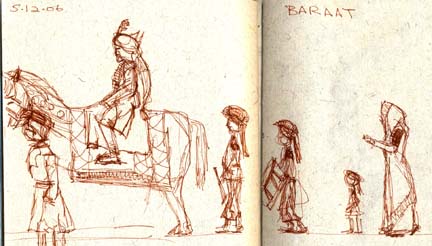
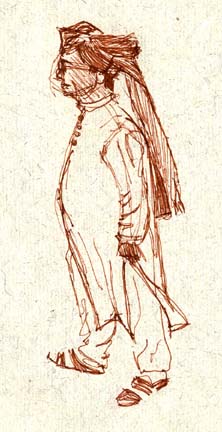
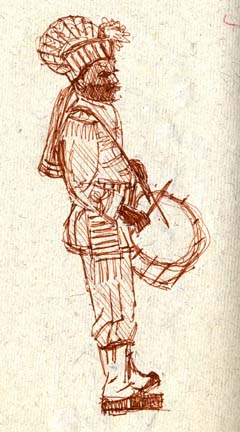
By the way, the reason that I was looking for a picture of a bridegroom on horseback in the first place is that I suddenly envisioned myself painting a long picture of a wedding procession, with the bridegroom, the marriage band tootling off-key but with great spirit, the guests and family members dancing. Not that I'm likely to accomplish it, but I had made some sketches earlier, when a baraat (wedding procession) passed our house -- of the bridegroom, a wedding guest, and musicians from the band:



Waziristan?

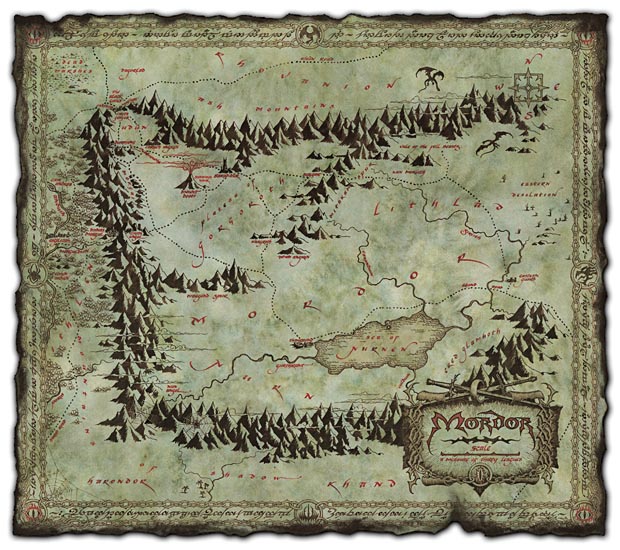
I saw it on Wide Island, who/which in turn found it on Registan.net, a blog about Central Asia: a news item in the Paktribune on 19 January, with the headline: 90 militants killed in S Waziristan clashes Big offensive on the cards; warplanes target hideouts. The story is straightforward, but the map of Waziristan which accompanies the article


looks suspiciously like another place altogether.

Blather

From an article by Louis Menand, on diaries, in the December New Yorker:
... If it doesn't contain a lot of dross, it's not a diary. It's something else -- a journal, or a writer's notebook, or a blog (blather is not the same as dross).

Sigh. (The sigh is the blather.)

India Shining

All the media everywhere seem to be trumpeting the rise of India. And it is something to experience. The poor seem to be as poor as before -- and prices are rising rapidly -- while the middle class rises, and the wealthy have become more visible than ever before.


The weekly news magazine, India Today, sends out glossy supplements filled with very expensive gewgaws -- e.g., watches costing hundreds of thousands of rupees -- and I wonder how many of its readers can afford them.


Vogue magazine began publishing an Indian edition last fall. I was never a reader -- it looked like something from another world, even when I lived in America. But I bought the December issue, and gawked at it, all the beautiful photographs of beautiful people. (The first three pictures here are from Vogue.)


Last week I fell for an ad for an apartment development in Whitefield, outside of Bangalore, called Windmills of Your Mind. Yes, really. Beautiful duplexes, and Bangalore's cool weather (getting warmer, like everywhere else; but still a big improvement on Chennai). I've been dreaming about it. R says that we could buy such an apartment here in Chennai, and it would be air-conditioned anyway... but I don't think there are such buildings here. Anyway, all this fabulosity doesn't seem conducive to a peaceful mind. How do they bear it, the vast, vast majority who can't even dream of possessing any of it?

To Boredom

A lovely poem by Charles Simic, from the New Yorker:
To Boredom

I'm the child of your rainy Sundays.
I watched time crawl
Over the ceiling
Like a wounded fly.

A day would last forever,
Making pellets of bread,
Waiting for a branch
On a bare tree to move.

The silence would deepen,
The sky would darken,
As Grandmother knitted
With a ball of black yarn.

I know Heaven's like that.
In eternity's classrooms,
The angels sit like bored children
With their heads bowed.
Indians are obsessed with getting into the Guiness Book of World Records. They do the most absurd things to achieve this, and they succed. Last night on TV, a man broke 200 coconuts in two minutes with his elbow. R says the Guinness Book should be renamed the Ganesh Book of World Records.

Three Words

a Hindi/Urdu word for beautiful girl (hasina) rhymes with that for perspiration (pasina). Songwriters never used to take advantage of this -- their lyrics were generally high-flown and romantic -- but now they do. E.g., 'When I saw the beautiful girl I broke into a sweat.'

I love the Urdu word 'chilman' -- it's a pleasure to say it. It is a split bamboo or reed curtain. It has implications of concealing / revealing. It's a poem in a word.


Photograph by Ramesh Gandhi -- one of a series of photographs of chilman / chick blinds, which begins with pristine newness and ends with complete disintegration: here.

Several Things

Saw Rajat Kapoor's film Mixed Doubles on TV last night. I cracked up over this Hinglish line:
Get out ho jao!


I was driving in Adyar today, when I saw a long line of red firecrackers tied together, stretched out in the middle of the opposite lane. They went off like gunfire, and just beyond them was a fish-cart carrying a couple of drummers, with dancing men on the road behind them. Then a larger cart pulled by more men, with a high, ornate cane structure like the head of a bed, and the corpse under masses of flowers, only his face visible. All the men – there were no women – were poor and sinewy, wearing lungis tucked up to their knees. A couple of men brought up the rear, throwing flowers onto the road, so that it was thick with red rose petals. I have seen all this many times, of course, but never with firecrackers.


I heard a beautiful song last night, by Kailash Kher, and I’ve been hunting for it today, without success. It had a recurring line: ‘nikla hun main.’ If anyone who reads this can identify it for me, I’d be grateful. (update: the song is written by Aditya Thakaray, grandson of Bal Thakaray. He has just put out an album of his poems sung by many singers. This song, Ek Khoj, is one of them. 'Ek khoj par nikla hun main, nikla hun main...' )

Currency

Things have changed so much in the last ten years that I feel like a Neanderthal sometimes, explaining to wide-eyed young things about import restrictions and Permit Raj (R knows this at first hand, much more than I do, of course), and the politics of scarcity and such. The particular aspect of the past that popped into my head last night, as I waited for sleep, was this:

We have ATMs now – we didn’t when I arrived here – but when I need cash I call the bank and they send someone around with bundles of notes. I specify whether I need 500s, 100s, 50s. They used to provide 20s and 10s, but they don’t anymore. (One rupee notes don’t exist anymore, and fives are scarce – they’ve become coins. My mother-in-law kept a dish of coins to give to beggars outside the temple, and a lot were left after she died, including 1- 2- 5- 10- and 20- paise coins. None of them exist now. I liked the 2 paise coins especially – circles with scalloped edges. The 5 paise coins were square; all made of some dinky metal, very light… Just to get rid of them, I took most of them to a Barista one day and paid for my coffee with them, and everyone gathered round and oohed and aahed until I wondered if I had made a mistake. They gave me a free cup of cappuccino, too.)

Ahem. So when these notes would come, they would be held together on one side by a large, heavy staple, put there by the bank. The first thing you would have to do when you wanted to spend one, was to pry open the two ends of the staple and struggle to disengage the note(s) from the bundle without destroying them. If you looked at the side of an older note you could see a lacework of holes, as the notes repeatedly returned to banks and were sent out again. I developed a technique of prying open the staple with a metal letter opener, grasping two halves of the bundle in two hands and wrenching the whole thing apart, but stopped after the time I destroyed half a bundle of 50 rupee notes. The other way, if the notes were old and thin, and the staple was particularly cruel, was to open the staple but leave it in the bundle, carry the bundle in your purse, and pry the notes away one by one in the shop. And cut your finger on the staple ends in the bargain.

When you hand someone cash, especially if it’s at a small shop or stand, the shopkeeper will inspect the note carefully – if there is a slight tear or disfiguration, you will likely get it back. Though the same person will happily give you change in bills which consist of two halves taped together. Then you argue, and s/he shrugs, or grins sheepishly and takes it back…

Anyway, now the bundles of notes come wrapped neatly in paper, and there are no more staple holes. Things have become so easy now, mes enfants, that I thought I should tell you about the wild old days, when we were young.


(There's a picture of the Indian coins at Joel's Coins - page down to the last image.)

Dashboards

The New York Times has an amusing (true) article about Indian traffic: Indians Hit the Road Amid Elephants

There's an accompanying slideshow. I loved the picture of a taxi's dashboard


because I keep thinking that I'd like to make a series of dashboard pictures -- dashboards with their various gods and adornments. Christian, Muslim, Sikh, Hindu, the dashboard can accommodate everyone.

This one is particularly ornate. The metal tissue box is common enough, but I usually see it on the shelf behind the back seat. There appear to be two perfume containers. There's a mala - a kind of Hinu rosary - hanging from the mirror. A tiny human figure? What's that? At its feet are some pictures, lying flat - perhaps of gods. I was told that people keep stuffed animals in their cars so that they will absorb any evil that may come to them -- if there's a collision, the toy animal will be 'injured', not you.

So I'm inspired anew to explore the dashboard world.

Our Neti Pot

The New York Times has an article on what it calls a neti pot - what you use to irrigate your nose. It's certainly not called a neti pot here, but I don't know the word, so... I remembered that there was one among my late mother-in-law's things, and decided that it was time to try it out. I watched a YouTube video on how to do it -- only the person in the video used something called 'neti pot salt', while I used the salt that we have, which is iodised. Will I get cancer?

Anyway, it's done. I didn't like it -- the water ran out of my nose and down the side of my face, and when I bent over afterward and snorted as directed, it came out of my nose and my mouth, and it was pretty much like being in the ocean and getting seawater in your nose. My nose does feel clean and all, though, so maybe I'll try it again sometime.

This is our family neti pot (that's a very small flower):

William Dalrymple on Benazir Bhutto

William Dalrymple, travel writer, historian and sharp observer of South Asia, has written an excellent piece on Benazir Bhutto for the Guardian: Pakistan's flawed and feudal princess -- take a look at the very interesting comments as well.

A Glimpse of Kalakshetra in the Seventies

I just read a terrific article by a woman who studied bharatanatyam at Kalakshetra in the seventies -- as I did: Sleeping With Movie Stars, by Gitanjali Kolanad. My experiences were not exactly the same (I didn't sleep with any movie stars, for example), but she made me remember that time and place very vividly.

I also admired the dancer who played Lakshman, though I never tried to do anything about it. I also remember Rukmani Devi saying that a dancer is a dancer not only in class or on stage, but always... although I haven't benefited much from that piece of wisdom. Small kids called out 'vellakarchi' ('white girl') when I passed, as they did to her. I thought I might die before I completed the 'tat adavu' ...

Thanks to India Outside My Window for the link.

Chennai Superstars

This is hilarious -- it's a TV ad for the new Indian Cricket League, for the Chennai team. It's a spoof on the superpowers of Tamil film superstars. Thanks, Viji!

Bandicoot

Last night I went into the kitchen. As I turned on the light a big bandicoot came out from under a counter and appeared to be charging at me. Though it might have been trying to get out of sight. But still. I uttered a kind of groaning sound and ran, or walked very fast, back through the dining room and into the drawing room where R was doing Sudoku. I said dramatically, "There's a big bandicoot in the kitchen!" He looked up briefly, said, "Go call Mary," and went back to the puzzle.

I went out back to Mary's room and apologetically woke her up. She got up enthusiastically, though, and grabbed a mopstick, hoping for a chance to bash the rat. We went inside together, I strewed poison cakes around, she tapped everything with the stick, but nothing emerged. Mary went back to bed and I returned to R.

He looked up again and said, "What happened?" I told him, and he said, "So, did it hiss at you?" "What??" "The little chuchunders don't hiss, but the big ones, if you turn on them they'll open their mouths." I said, "I didn't turn on it, I ran in the other direction." He gave a condescending laugh: ha-ha-ha-ha-ha-ha. So I did the same to him: ha-ha-ha-ha-ha-ha.

In the night I dreamed that the Mongol hordes had come and were rampaging around upstairs, while we cowered in a small room. I had a bunch of very knobby, odd-looking jewelry, which I concealed about my person -- not a good idea, probably, with hordes of any kind. Eventually they left.

In the morning I came downstairs. A pipe that had been blocked was now wide open -- the bandicoot had discovered it somehow, and chewed through the blocking material, and escaped. I stood with Mary and Lakshmi, pondering over the giant droppings, sharing details of the exciting story, and wondering how the thing had gotten into the house in the first place.

Here endeth the wildlife story of the day.

Gooseberries


Eating/admiring cape gooseberries ('geuzbrees'). Orange/green/yellow gleaming spheres enclosed in veined onionskin paper. Sweet-sour. Sweet.