Demolition Day

Photo by R. Ragu

The Admiralty House, one of Chennai's few remaining fine old buildings, is being demolished. From The Hindu:
CHENNAI: The demolition of the Government House here, the oldest building on the Government Estate, has begun.

On Monday, workers were breaking the roof of the heritage building, commonly known as the Admiralty House, with giant hammers. The demolition will be completed in 40 days, according to an official of the Public Works Department, the custodian of the Estate properties. Some other buildings on the Estate will also be demolished, including the old MLAs’ quarters. The official says that as the buildings are vacated, they will be pulled down. The department hopes to complete the demolition of all the identified buildings by the end of next month.

The exercise is being carried out to facilitate the execution of the Rs. 200-crore Assembly complex project.

The government has selected a German-based architectural firm for the Assembly project. As per the present proposals, there will be two blocks – one housing the Assembly complex and offices of the Chief Minister and Ministers and the other accommodating offices of various government departments. While the first block will have ground and six floors, the second is likely to be a high-rise building, having a maximum of 20 floors. The government is planning to commence the construction of the proposed Assembly complex by September.

Till recently, the Government House building was occupied by the different wings of the Police department such as Crime Branch-Criminal Investigation Department (CB-CID) wing, the Economic Offences wing and Narcotics Intelligence Bureau-CID. The wings have been shifted to different places in the city. In the mid-1990s, the building, as a makeshift arrangement, even served as the headquarters of the Police department when the government undertook renovation of the DGP office building on the Marina, which is yet another heritage landmark. Till Independence, the Government House was the residence of Governors. For sometime, it also functioned as the MLAs’ hostel.

S. Muthiah, historian, wrote about the importance of the heritage monument on several occasions in The Hindu. In his column on October 29 last year, he wrote that after the French left the Fort St. George’s buildings in a shambles, Governor Thomas Saunders of the British East India Company in 1752 rented a house belonging to the wealthy Mrs. Antonia de Madeiros just across the Island from the Fort. On August 28, 1753 the Government of Madras bought the house for 3500 pagodas to serve as the Governor’s garden house. Only in 1947 did the Governor’s residence move to the present location in Guindy – Raj Bhavan.

Blogday


Goodness gracious, it's my blog's birthday again. The fifth. Happy blogday to me.

And thank you, those who still come around and take a look once in a while.

More Climbing

Jillu Madrasi told me about this YouTube video, about a man who has invented a better way to climb a coconut tree. Wonderfully simple, effective technology:

The Sun

April is National Poetry Month, and every year Knopf sends me a poem a day during April. (Though it's a bit late, they'll send you one too, if you send a blank email to: sub_knopfpoetry@info.randomhouse.com. They'll keep you on the list for next year, too.)

I received the most wonderful poem yesterday, by Dan Chiasson, from his book Natural History:
The Sun

There is one mind in all of us, one soul,
who parches the soil in some nations

but in others hides perpetually behind a veil;
he spills light everywhere, here he spilled

some on my tie, but it dried before dinner ended.
He is in charge of darkness also, also

in charge of crime, in charge of the imagination.
People fucking flick him off and on,

off and on, with their eyelids as they ascertain
with their eyes their love's sincerity.

He makes the stars disappear, but he makes
small stars everywhere, on the hoods of cars,

in the compound eyes of skyscrapers or in the eyes
of sighing lovers bored with one another.

Onto the surface of the world he stamps
all plants and animals. They are not gods

but he made us worshippers of every
bramble toad, black chive, we find.

In Idaho there is a desert cricket that makes
a clocklike tick-tick when he flies, but he

is not a god. The only god is the sun,
our mind—master of all crickets and clocks.

Numbers

I just finished reading an article in the March 3 New Yorker, “Numbers Guy – Are our Brains Wired for Math,” about the work of Stanislas Dehaene. I was particularly interested in this paragraph:
Today, Arabic numerals are in use pretty much around the world, while the words with which we name numbers naturally differ from language to language. And, as Dehaene and others have noted, these differences are far from trivial. English is cumbersome. There are special words for the numbers from 11 to 19, and for the decades from 20 to 90. This makes counting a challenge for English-speaking children, who are prone to such errors as “twenty-eight, twenty-nine, twenty-ten, twenty-eleven.” … Chinese, by contrast, is simplicity itself; its number syntax perfectly mirrors the base-ten form of Arabic numberals, with a minimum of terms. Consequently, the average Chinese four-year-old can count up to forty, whereas American children of the same age struggle to get to fifteen….

I have a hard time with Hindi numbers (partly, of course, because I don’t use them often) – anything over 50 is confusing for me. From 10 onward, the numbers are irregular – for example 10+1, which logically would be das-ek or ek-das, you have gyarah, and every decade has its own oddities. 21 is ikis instead of ikbis (ek+bis – 1+20). And what about the 50s? Pachaas, 50, is followed by ikaavan, rather than ikpachaas (1+50), and then baavan (52), and then trepan – not trevan – so even within the decade it’s weird. Sheesh.

Tamil, on the other hand, is very logical. Except for 90 and 900, once you know the system you can count anything. Eleven is 10+1, not a special word like 'eleven.' After 20 (iruvathu, i.e. 2 tens), you have 20+1 , 20+2, etc. Simple. (Aha -- I just noticed that there is some variation between p and v, just as there is in my Hindi example above -- e.g., 20 is iru-vathu, while 30 is mu-p-pathu -- so the Santhi rules for joining letters together are coming into play in both cases.)

Is this understandable? I’m putting it in a cumbersome way. And I'm sure my spelling of the words for Hindi and Tamil numbers is atrocious.

The article made me wonder if Tamil children pick up counting faster than Hindi-speaking children – the system is more logical, so there’s less rote memorization required of small children. At the same time, Tamil is more polysyllabic than Chinese, so Chinese children might have an advantage over Tamil children, but not as much of one as they have over English-speaking children…

What do you say?

Gravy

I was wondering what to make for lunch today, and I had a sudden craving for one of my father's favorite foods: bread and gravy. He grew up poor, born in West Virginia, and moved around the midwest as a child by his father, looking, apparently not very successfully, for work. My father sometimes described himself as a hillbilly, or 'mountain William,' though he had been away from the hills for many decades by the time I knew him. He loved what now looks like poor people's food: bread and gravy; fried cornmeal mush (perhaps that's polenta to you); scrapple. Stodgy comfort foods, which eke out small amounts of meat.

We generally don't have meat in the house -- our kitchen is no-egg vegetarian -- but I lapse on occasion. I had had a roast chicken delivered a couple of days ago. So I stripped the meat off the bones and boiled up the carcass, made a roux of flour and butter, poured in the hot stock, added salt and pepper, and made a thick gravy. I poured it over the white Wonder-type bread that my staff takes with morning coffee and afternoon tea.

While I cooked I thought about my father, and remembered our family's only trip, when I was quite small, to Fairmont, West Virginia, where he was born. We met his very elderly Aunt Veedie, who invited me to choose one of her crocheted doilies as a gift. I horrified my parents by selecting the only one that was not plain white -- the yarn was heavily splotched with purple and yellow. But Aunt Veedie was pleased, saying that she called it her Aurora Borealis doily.

Two slices of white bread smothered in chicken gravy, and it was so good.

Coconut Stem Cluster


One of the stems cut down by the coconut tree man. Destined to replace this one, which broke away from its sheath.

Coconut Medicine 2

Today the ingredients of the poultice were assembled: turmeric, moth balls, rock salt, Sam's Fortified Neem Powder. The tree man supervised their mixing, put the medicine in a bag which he attached to his holster-basket, and began to climb. First he slung the longer rope -- partly covered with black rubber for extra traction, perhaps an old bicycle inner tube -- around the trunk above his head, tied the ends together to make a ring, and kept a smaller ring of the same material around one ankle. he jumped up onto the trunk, pulling himself up with the large ring, and rested both feet on the smaller one.


In this way -- throwing the larger ring upward and bringing up his feet -- he continued up the trunk like an inchworm. The palms' crowns must be about 30 feet high.


He climbed up to the base of each crown, cut down the lowest ring of leaves with his machete, along with whatever coconuts were ripe, dried-up leaves, and stem clusters from which coconuts had already been harvested. Finally he applied the medicine around the coconut stems and came back down. Each tree took about half an hour, and he charged Rs. 50 -- a little more than a US dollar -- per tree. He also carries away the cut leaves, which are made into rough brooms or coarse woven mats for thatched huts.

What strength he requires, to climb those tall, branchless trees and to do so much tending, without any more support than two rings of rope!

Coconut Medicine

Our cook, Mary, is the in-charge for our three coconut trees. She tells the gardener when to cut the ripe coconuts down, and monitors their quality. A couple of days ago she told me that the coconuts have become dry -- she brought a pot full of halved fruit, to show me the white flesh.

I suggested that she call the coconut tree man. He had come at about this time in 2006, when the coconuts were falling before ripening, and did the trees a lot of good by climbing up to the crown and applying a poultice made from rock salt, mothballs, sambrani (a kind of incense), turmeric and edible camphor, bound with oil.

The coconut tree man in 2006. He has a heavy black rope slung over his shoulder, and wears a cone-shaped basket for his machete. The gardener is mixing up the poultice.

The prescription for dry coconuts is different. In addition to camphor, turmeric and salt, he wants something called vepampunakku, which he says is available from nurseries. Sadly, the nursery which I used to go to, the enormous and serene Saundarya, has long gone to development, and most nurseries are in the suburbs. (For that matter, the coconut man himself lives in the Srinivasapuram slum, which is about to be emptied and its inhabitants transported to a distant project – what will we do then?)

Mary discovered from him, and told me, that vepampunakku is a paste made from the seeds of the vepam tree, and that we have one in our garden –a smallish slender tree. She said that the fruits are also medicinal, but that the crows eat them all.


If anyone knows more about the vepam tree, or vepampunakku (and where to get it!), I’d be interested to hear about it. update: Now I feel silly: vepam is neem, it turns out. So that's why it's in our garden. Though I don't know why it's so scrawny -- neem is a big, spreading tree. Even its shade is supposed to be healthy. My gardener rode his bicycle to a nursery in Adyar and bought bags of "Sam's Nutri Neem-Plus 100% Pure Neem Powder, Fortified with Turmeric, Castor, Pungam and Illupai." Rs. 25 per kg. I still don't know what pungam and illupai are...

Welcome to Khaufpur

The very clever website of the city of Khaufpur -- a city which does not exist.

Khaufpur is the setting for a novel which was reviewed in the NYT today: Animal's People, by Indra Sinha. The book was a finalist for the 2007 Man Booker Prize. Khaufpur represents Bhopal, the site of the disastrous 1984 gas leak from the Union Carbide chemical plant (Khauf = fear).

I checked out my horoscope in Khaufpur's Astrology section, maintained by Shri Shri Shadangi Maharaj:
Capricorn: Your sense of humour is needed right now but remember that all things are sent to try us and that the universe is a joke of the Upstairs One so don't life too seriously. Err on the bright side and remember chicken pox only last three weeks.

I was also intrigued by Khaufpur's heritage liqueur, Kesar Kasturi, "a liqueur imbued with saffron and musk". That could inspire some khauf all by itself.

Your Indian Wedding


I was looking for a picture of a bridegroom riding a horse, in the north Indian wedding style (what R calls a horse being ridden by a donkey), when I came across this site in California: Fancy Wheelin'.
We pride ourselves on using "safe" horses that have the correct temperment for a festive Indian Wedding. They are comfortable with the dohls and high energy of a wedding event.


Here's another one, in New Jersey, Pony Share. They offer, among other things: "The ability to match the groom with the right size horse" and "A fleet of modern trucks and trailers, equipped to prevent lateness and break-down as well as a back-up plan."
Our choice of decorations and matching umbrellas is yet another reason why our service is second to none! Ours are not bargain basement "plastic type" or quickly put together "Rag shop pieces"!


Each set of our imported decorations has been carefully handcrafted in Rajistan (sic) with only the finest materials, cloth and dazzling beads. The sets consist of 10-12 pieces!.Not the standard 6 and we will also match a free umbrella to go with your set, just for the asking!


You can also get your mandap (pavilion) made by ... Mandap, in New Jersey.


Or why not just go to India for your Indian wedding? A-Z Tours offers to arrange the whole thing:
We can arrange all of this for your marriage or if you are married and want us to organize this for your Wedding Anniversary as a Mock Wedding we can do this as well for you. Just for your information, we would like to give you an approximate price which will be a minimum of USD 5000 for the arrangements as mentioned below. It can change according to your choice also.
1. Venue for the wedding
2. Horse, camels, elephant
3. Fire works
4. Buffet Dinner
5. Brass Band
6. Mandap [ The place which is used for rituals at Bride’s place ]
7. Pandit [ The Hindu priest for rituals ]

We can arrange this for one couple with 50 invitees, if you want to come alone we will invite guests on your behalf who will be a witness for your marriage as well.


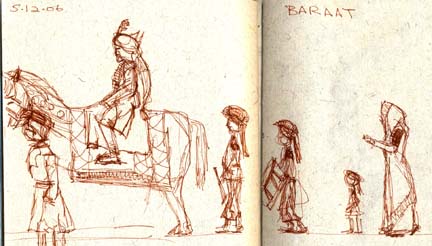
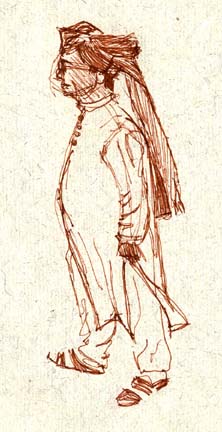
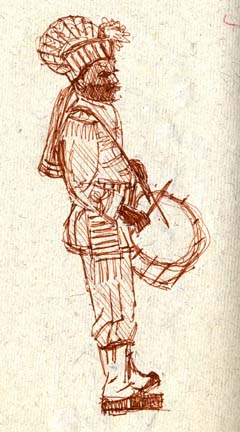
By the way, the reason that I was looking for a picture of a bridegroom on horseback in the first place is that I suddenly envisioned myself painting a long picture of a wedding procession, with the bridegroom, the marriage band tootling off-key but with great spirit, the guests and family members dancing. Not that I'm likely to accomplish it, but I had made some sketches earlier, when a baraat (wedding procession) passed our house -- of the bridegroom, a wedding guest, and musicians from the band:


Waziristan?

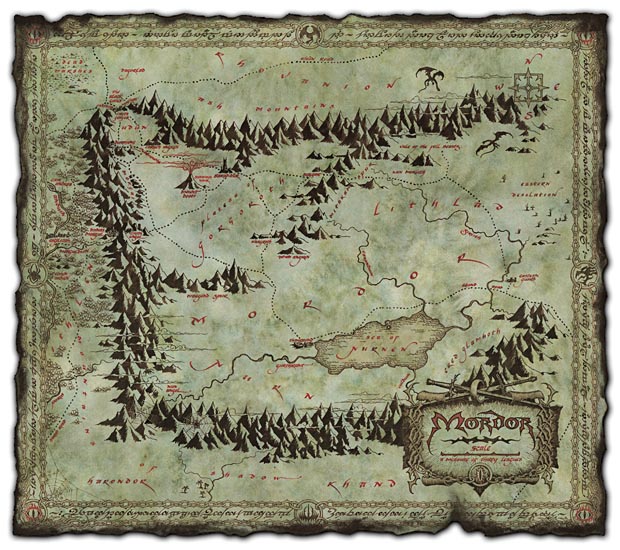
I saw it on Wide Island, who/which in turn found it on Registan.net, a blog about Central Asia: a news item in the Paktribune on 19 January, with the headline: 90 militants killed in S Waziristan clashes Big offensive on the cards; warplanes target hideouts. The story is straightforward, but the map of Waziristan which accompanies the article


looks suspiciously like another place altogether.

Blather

From an article by Louis Menand, on diaries, in the December New Yorker:
... If it doesn't contain a lot of dross, it's not a diary. It's something else -- a journal, or a writer's notebook, or a blog (blather is not the same as dross).

Sigh. (The sigh is the blather.)

India Shining

All the media everywhere seem to be trumpeting the rise of India. And it is something to experience. The poor seem to be as poor as before -- and prices are rising rapidly -- while the middle class rises, and the wealthy have become more visible than ever before.


The weekly news magazine, India Today, sends out glossy supplements filled with very expensive gewgaws -- e.g., watches costing hundreds of thousands of rupees -- and I wonder how many of its readers can afford them.


Vogue magazine began publishing an Indian edition last fall. I was never a reader -- it looked like something from another world, even when I lived in America. But I bought the December issue, and gawked at it, all the beautiful photographs of beautiful people. (The first three pictures here are from Vogue.)


Last week I fell for an ad for an apartment development in Whitefield, outside of Bangalore, called Windmills of Your Mind. Yes, really. Beautiful duplexes, and Bangalore's cool weather (getting warmer, like everywhere else; but still a big improvement on Chennai). I've been dreaming about it. R says that we could buy such an apartment here in Chennai, and it would be air-conditioned anyway... but I don't think there are such buildings here. Anyway, all this fabulosity doesn't seem conducive to a peaceful mind. How do they bear it, the vast, vast majority who can't even dream of possessing any of it?

To Boredom

A lovely poem by Charles Simic, from the New Yorker:
To Boredom

I'm the child of your rainy Sundays.
I watched time crawl
Over the ceiling
Like a wounded fly.

A day would last forever,
Making pellets of bread,
Waiting for a branch
On a bare tree to move.

The silence would deepen,
The sky would darken,
As Grandmother knitted
With a ball of black yarn.

I know Heaven's like that.
In eternity's classrooms,
The angels sit like bored children
With their heads bowed.
Indians are obsessed with getting into the Guiness Book of World Records. They do the most absurd things to achieve this, and they succed. Last night on TV, a man broke 200 coconuts in two minutes with his elbow. R says the Guinness Book should be renamed the Ganesh Book of World Records.

Three Words

a Hindi/Urdu word for beautiful girl (hasina) rhymes with that for perspiration (pasina). Songwriters never used to take advantage of this -- their lyrics were generally high-flown and romantic -- but now they do. E.g., 'When I saw the beautiful girl I broke into a sweat.'

I love the Urdu word 'chilman' -- it's a pleasure to say it. It is a split bamboo or reed curtain. It has implications of concealing / revealing. It's a poem in a word.


Photograph by Ramesh Gandhi -- one of a series of photographs of chilman / chick blinds, which begins with pristine newness and ends with complete disintegration: here.

Several Things

Saw Rajat Kapoor's film Mixed Doubles on TV last night. I cracked up over this Hinglish line:
Get out ho jao!


I was driving in Adyar today, when I saw a long line of red firecrackers tied together, stretched out in the middle of the opposite lane. They went off like gunfire, and just beyond them was a fish-cart carrying a couple of drummers, with dancing men on the road behind them. Then a larger cart pulled by more men, with a high, ornate cane structure like the head of a bed, and the corpse under masses of flowers, only his face visible. All the men – there were no women – were poor and sinewy, wearing lungis tucked up to their knees. A couple of men brought up the rear, throwing flowers onto the road, so that it was thick with red rose petals. I have seen all this many times, of course, but never with firecrackers.


I heard a beautiful song last night, by Kailash Kher, and I’ve been hunting for it today, without success. It had a recurring line: ‘nikla hun main.’ If anyone who reads this can identify it for me, I’d be grateful. (update: the song is written by Aditya Thakaray, grandson of Bal Thakaray. He has just put out an album of his poems sung by many singers. This song, Ek Khoj, is one of them. 'Ek khoj par nikla hun main, nikla hun main...' )