Bleah!

My latest post on Metroblogging Chennai: Bleah! or, Current Architectural Trends


Look at this poor, architecturally-challenged creature. I am posting it not because it’s ugly — we have plenty of ugly buildings to look at out our windows as it is — but because it represents three of the city’s current architectural trends:


First, see a portion of the building on the left. This is the way most of the city’s buildings look: no architect consulted; slabs extending over the windows to act as sun / rain shades; general boxiness. Flat roofs; generally many small rooms.
If you look at the side of the building in the center, you can see that it is really the same as its neighbour.
The upper part of the facade, made of reflective glass, typifies the new buildings coming up here, of which this is a very modest version – most of them look as weird in their context as if an alien spaceship had come down in (in this case) Santhome High Road.
And finally, we come to the street-level facade, in a style which refers to Tamil traditional domestic architecture: tile roof, columns, verandah. I like this style a lot, myself, and it has come back into fashion once again, primarily for expensive houses — for people who can afford nostalgia, while concealing inside all the modern conveniences.
Any one of these three styles would have been fairly unexceptional in the Chennai of today; it is the combination which makes this a remarkable object lesson in how not to make a building.
R and I got our names in the paper today: a nice article in The Hindu's MetroPlus section, by Geeta Padmanabhan: What symbolises Chennai? Think Chennai, and what strikes you — the city's landmarks, its tradition, culture or people?

Two other Chennai bloggers were also quoted: Thennavan and Vatsan. (The three of us also contribute to Metroblogging Chennai.)

A Village Toy


I drew and watercoloured this small bullock toy today. It has holes drilled in the platform so that wheels can be added. The thread-garland around its neck was the handle of a shopping bag from Anokhi.

My painting doesn't capture the roughness of its texture. I put a photograph of the original on Flickr.
I love this sentence, from Tahir Shah's The Caliph's House. He's describing the morning of bakr-id, in the slum near his house:
The donkeys had fallen silent, as had the limping dogs; and the wicked boys had been hosed down and dressed in white.

Wall-Painting

I love the vanishing hand-painted signs / murals. I took this photograph today, on Chamiers Road:


And one more, on Flickr

????

In what folds and crevices of the brain do these things reside: just now, out of nowhere, I began to sing under my breath
I'm Popeye the sailor man
I live in a garbage can
I love to go swimmin'
with bald-headed wimmen
I'm Popeye the sailor man

I'm not even a fan of Popeye, though I do like the way his muscles ripple after he has sucked in the spinach - the tattooed ship under full sail on his bicep begins to toss and pitch in the swells.

Go figure.

Tommy and Aruna

Here we are in the Irony Department. It's a cheap one, I know, but pretty striking all the same:


Now take a look at the lower right-hand corner of the picture, at the little blue shed containing Aruna Automobiles All Two Wheeler Service. Here it is in its proper scale:

Sandesh

R's childhood friend has come to visit from Calcutta, bringing a carton of langda mangoes and a box of sandesh, one of R's favourite Bengali sweets. I believe that 'sandesh' means 'message.'


Sandesh is made from paneer. I have seen my sister-in law make it in Chicago, mixing paneer and sugar in a food processor, then stirring it in a wok over a low flame until it became a little less moist, then rolling it into lozenge shapes and decorating it with mandarin orange slices.

The modern version has many added flavourings. Here's a tour of the plate above: the yellowish squares are, according to R and his friend, the classic form of sandesh, with saffron and pistachios, and decorated with silver foil. "We never knew that sandesh could be white (the most common colour now - unless it's sweetened with jaggery, which colours it pale tan). Only in the villages would you find white milk sweets."

Next are slices of plain sandesh surrounded by sandesh flavoured with rose water and dyed pink. Decorated with chopped pistachio and saffron threads.

In the center are two large pieces, strongly rose-flavoured, decorated with fresh rose petals, resting in individual trays made of folded and stapled pieces of banana leaf.

Then, two balls of plain sandesh enclosing chocolate and rose petals and decorated with silver foil.

The cool soft graininess of sandesh, the freshness of rose petals (small and dark blood red, roses from before the essence was bred out of them): what a delicate message they convey.

Boozards

I went out yesterday morning to buy some beer.  Before the state government took over the liquor business, one could enter a respectable place and choose from a fairly wide selection of Indian liquor (no wine, though, even though there is quite decent Indian wine, and even though liquor stores are called Wine Shops).


Now, though, the liquor stores are filthy, with only the cheapest brands on sale, and are apparently intended to convey the message that if you keep alcohol in your home you are destined for one of the lower circles of hell.  Drink in hotels or clubs (independent restaurants aren't allowed to sell alcohol) - fine.  Drink at home - hell.

I went to a Wine Shop on the corner of Mandaveli High Road and C.P. Ramaswamy Road, because I was headed to Cinema Paradiso.  I walked inside the gate.  A group of what the Indian press used to call boozards clustered around the doorless opening to the Wine Shop.  To the left was a makeshift stall featuring some kind of bright orange-red fried snacks.  I walked through the assemblage to the counter, told the man inside that I wanted some Kingfisher beer, which fortunately he had, and waited while he hauled a case from the back of the small room.

As I stood there, I felt a tapping on my shoulder.  I turned, and a horrible looking, toothless fellow grinned at me and said, "Hello, Madam."  I said quietly in Tamil, "Don't touch me."  He immediately stepped back, and one of his comrades said, "Sorry Madam."  I paid for my beer and carried it out to my car.  It was nothing at all, really, it ended almost as it began; yet it upset me.

I would be grateful if someone could a) tell me where to find a decent Wine Shop in Chennai with a good selection of stuff; and b) why did the Government take over this business in the first place?  They were already auctioning off licenses to run the Wine Shops for large sums, and there's already a tax on every bottle sold.  Why did they need to take over alcohol retailing?

The beer was good.  But that's another story.

Clouds

I called the clouds, and for once they responded. I was sitting in a cane chair on the lawn at about 5:15 in the evening, resting my head on the back of the chair and looking straight up at the sky. A procession of clouds, white around their frayed edges and raindark in the middle, headed east across a sky of the palest blue. It was very beautiful, and I thought of Meghdoot, the Cloud-Messenger, carrying its message of rain.

Next came a thin, even sheet of yellow-grey, which spread to cover most of the sky, and sent down the lightest of sprinkles - not even a drizzle - that went on for an hour.

Later there was a more definite shower, with lightning and thunder. Water splatted loudly on the leaves in our leaky atrium.

This morning the sky is bright but grey-tinged, the air is heavy, and the stones of the garden walkways are patched with damp. Perhaps more rain-mail will come today.

At Play

I've been reverting to childhood lately: cutting paper and pasting it to more paper; only the scissors don’t have round ends, and the paste isn’t thick white goop, in a round jar with a brush attached to the lid. It was so enjoyable: no worries about not being able to draw, or how the wash will come out, or lost edges or any of that stuff.

Some friends dropped by with a wedding invitation, and it was so pretty that I grabbed it from R’s hands and lost all interest in the happy event (R was busy anyway, giving them a lecture on the wrongness of extravagant weddings, and the worse wrongness of inviting him to attend them. They didn't mind - we had just gone through the same routine a month ago, with another daughter.). Almost as soon as they left I cut it up and made it into a pocket,


and put in a picture of myself, taken 100 years ago or so, in a kathak pose, and a gift tag with a quotation from a letter which someone wrote to me, in Urdu, at that time:
How can this eastern candle (me!) burn in the palaces of the West?

I glued in the picture of Theda Bara as Cleopatra, to signify that the writer was having a little Orientalist fantasy of his own.


I went on to make several more pockets. I’m planning to bind a book with black pages and glue them in, as in a photograph album. The title of the book will be Où Sont les Neiges, which has two meanings:

1. Où sont les neiges (d’antan) (Where are the snows of yesteryear), because a lot of it will be about the past, about memory; and
2. Où sont les neiges because I live in the tropics, and ou sont les damn neiges, anyway?

Or because it's a monsoon land, maybe I can call it Où sont les nuages? I don't know. Anyway, on - or back - to paper dolls. Or mudpies, or something.

The Caliph's House

I've been enjoying The Caliph's House by Tahir Shah. It tells the story of his and his family's relocation from England to a huge, old mansion in Casablanca, its renovation, and the characters living in it, both human and supernatural (jinns, that is).


(This picture is from an article in the New York Times)

I'm one of those who enjoys looking at pictures of pretty houses, though I feel a little guilty about it: Our house is pretty enough, but my eye still tends to roam. Anyway, Shah's website includes a section of photographs of the Caliph's House, taken after the dust had settled, and jinns and eccentric local characters had been appeased.

Here's the India tie-in: Shah, whose wife is Indian, ordered a container-load of furniture for the house on the Internet, from a company in Bombay: The Raj Company. The photograph below is from their website:


So that's it - something to look at on an idle Sunday.

Titli and Meghdoot

We saw a perfect little gem of a film, Rituparno Ghosh's Titli. Titli, the pet name of one of the characters, means butterfly, and the movie was light and beautiful as its name. The three main actors - Aparna Sen, Konkana Sen, Mithun Chakraborty - were all excellent. Konkana is just remarkable. The script was gentle and understated, believable, full of quiet humour.

In one scene, Aparna Sen recites part of Kalidas' (middle of the 4th and early 5th centuries A.D.) poem Meghdoot. She recited from a Bengali translation of the Sankstrit original, which I read in the English subtitles, but still - the imagery was so beautiful that I wanted to read it again.

In Meghdoot, the Cloud Messenger, a lover, separated from his beloved, sees a cloud - it is the first day of the rainy season - and requests it to carry a message to her. He describes in great detail the route that the cloud must take in order to reach her, and the sights it will see on the way.

Here's the Sanskrit text with English translation, with links to more information about Kalidas and his works. Click on each line of the text to read the translation - it's a bit tedious because you have to pause after each line to click on the next, but it's worth it. Oh, and there's a second page, too - the link is also in Sanskrit, so you might miss it. These people (SUNY at Buffalo) are not interested in idle readers. Bless them anyway - the only other translation I could find was ghastly, rhymed doggerel.

Here are a few lines which I've lifted from here and there in the poem, just to give a bit of its flavour:
Even the mind of a happy person is excited at the sight of a cloud. How much more so, when the one who longs to cling to his neck is far away?...

The wives of travellers, holding back the tips of their locks of hair, taking courage from their confidence (in their husbands' return), will look up at you raised on to the path of the wind...

cranes, like threaded garlands in the sky, lovely to the eye, will serve you...

...the eyes of the country women who are ignorant of the play of the eyebrows, who are tender in their affection, and who are thinking 'The result of the harvest depends on you'...

You will see the river Reva spread at the foot of Mt Vandhya, made rough with rocks and resembling the pattern formed by the broken wrinkles on the body of an elephant....

you who have made a momentary acquaintance with the flower-picking girls by lending shade to their faces...

On the way, after you have ascended to the Nirvandhya River, whose girdles are flocks of birds calling on account of the turbulence of her waves, whose gliding motion is rendered delightful with stumbling steps, and whose exposed navel is her eddies...

Reveal the ground with a bolt of lightning that shines like a streak of gold on a touchstone to the young women in that vicinity going by night to the homes of their lovers along the royal highroad ...

which has been robbed of light by a darkness that could be pricked with a needle. Withhold your showers of rain and rumbling thunder: they would be frightened!...

I could go on quoting lines, but instead, please go and read it yourself. And see Titli if you have a chance. Rituparno Ghosh is a great film-maker. There are too many superlatives in this post, but it can't be helped.

A Cool Picture for a Hot Day

I borrowed picture and text from R's blog:


At a time when the Indian plains are seething and writhing with heat, staring at this picture, which I took years ago in Bangalore, may cool you off a little, as it did me and my guests.

Several Things

Vijaysree Venkatraman, writer of the excellent A Propos of Nothing, has an article in the Christian Science Monitor: A spice box and a cookbook got her started, which includes a recipe for Indian beans and peas.

The photograph of a spice box which accompanies the article was taken by the author of Mahanandi, a luscious-looking Indian and western food blog which I hadn't come across before.


Food ... mangoes.... eating mangoes twice a day. We started with the mangoes from our own tree, not very interesting but dear to me because I watched them swell up in their tree overlooking the badminton court. On to banganapallis from the fruit vendor's pushcart. Then one day I went out and bought a box of Alphonse mangoes from Maharashtra. When we put the first bite into our mouths, both of us emitted an involuntary 'aaah', and then laughed, because they were so luscious, so voluptuous...


The Gujarati word for 'right hand' literally translates as 'eating hand.' I wondered if the left hand might therefore be 'toilet hand' or 'unclean hand,' or something like that, but it isn't.


We hired a new gardener. He started out as our watchman, who moonlighted as an auto driver, but he asked us to hire him as a gardener because he loved that work. He only requested that we match his previous salary from the two jobs. We agreed, and we like him and his work. One week after he made the changeover, his slum of 200 thatched huts burned down. The government gave the affected families Rs. 1000 each; and some local charitable groups donated casuarina poles and palm mats - including matting impregnated with tar for the roof. We also helped him. He took two days off and rebuilt his hut.

Four days ago he again took two days of leave, sending a message that an insect had bitten his face and it had swelled up. That didn't sound right to us; we suspected that he had actually been driving the auto again, to make some extra money. When he returned, he told R the truth: his neighbours had claimed that when he rebuilt, he had grabbed an extra four feet of land. They broke the hut and beat him up.

Lakshmi says that he married a woman from the fisherman community, and lives with them, and that they are all rowdies. Whether that's true or not, it appears that a gardener is no match for them.

A few thoughts about three movies

After a hiatus from watching movies on DVD, we saw three in three days: Memoirs of a Geisha, (the latest) Pride and Prejudice, and The Constant Gardener.

1. The most stunning scene for me, in Memoirs of a Geisha, showed a long strip of red cloth floating in a brown-black river. The camera moves from above along the length of the cloth, and it seems to take forever. A more dramatic scene shows the geisha standing on a cliff and throwing a handkerchief into the wind. It's shot from a helicopter, which pulls away so that first you see only geisha and handkerchief, and then a huge landscape of rocks and sea.

In Pride and Prejudice Elizabeth stands on the edge of a cliff, thinking that she really ought to have accepted Darcy's proposal of marriage. The scene is shot from above, from a helicopter, so that we see her small in a big landscape.

In The Constant Gardener, Justin and the local British intelligence agent - or whatever they're called in England ('intelligence agent'? can that be right? It sounds so hifalutin', so Graham Greene) - have a scene on top of a cliff, shot from a helicopter to reveal a dry African landscape.

By this time I was thinking, What's this? Is the cliff-edge-helicopter-shot the new car chase -- i.e. a scene which must appear in almost every film? (A car chase delivered the actors to the cliff edge in The Constant Gardener.) Or these are three movies with cultural pretensions, and therefore they have put their characters on high?

2. R says that when a character in an American movie says "Would you like a cup of coffee?" in the next scene they will be having sex. That's nothing new, but in The Constant Gardener the transition from offer of coffee to sex was quicker and more seamless than ever before, and R asked, "Is western culture really like this now?" When I saw Quest for Fire (1981) I laughed: the prehistoric man sees a woman bending over, doing some work, jumps on her, she growls a little but accommodates him, and they both move on. It looked like a parody of modern Western life. But soon it may depict its reality.

The sex scene had a different look: it took place in the daytime and was full of bright, washed-out light. It was shot at such close range that the actress's skin actually had the texture of skin, it wasn't all smooth surfaces and highlights and shadows. Probably because the director was not from Hollywood, but Brazilian: Fernando Meirelles, who made the great City of God.

3. One thing that these three movies did NOT have was a toilet scene. Come to think of it, the toilet scene is the new car chase - certainly it's much cheaper to film. Years ago I saw an animation festival in Washington. In one film, a character sits on a toilet, and then one sees from below long green stalks of asparagus emerging from her backside. Soon we will be seeing the real thing. (At least one Indian film, trying to appeal to an overseas Indian audience -- Salaam Namaste -- has a toilet scene. There must be more that I haven't seen.)

Two ads for the same product are currently running on Indian TV: in one, you see a urinal flushing, with the voiceover saying that if you don't use the product you're pissing your money away. In the other a toilet is flushing, the camera looking down into the bowl, while the voiceover says, if you don't use the product you don't give a shit about your money. I feel incredulous each time I see these ads, but I realise that it's about copying western popular culture.

I've been away from America for so long that sometimes I don't get the cartoons in the New Yorker; or I gape at American movies and think "What is the world coming to?" -- maybe it's just me, moving quickly through time to obsolescence. It's comforting at such times to rest my mind on an image of red cloth weightless in brown-black smoothly flowing water.

Some Links

An Indian art ezine: Matters of Art (Via Self-Winding)

A very well-written blog, by someone based in Mumbai: Windy Skies

From the Pakistani newspaper The Daily Times: an article about Indian actors and singers who lived in Lahore before 1947 (via Metroblogging Lahore)

On the art front, One Mile From Home: "Walk a minimum of one mile from home. Record where you’ve been with a drawing, sculpture, photo or painting and then walk back. Every day for a year." Lovely stuff.

My new counter, over there on the side bar, from NeoCounter. According to it, in the two weeks or so since I installed it, I've had visitors from 92 countries! That's pretty exciting, even if many of them are searching for things they won't find here, like s*e*x pictures of T*w*i*n*k*l*e K*h*a*n*n*a. My unverified sense is that a majority of visitors are of Indian origin, so maybe this is a snapshot of the Indian diaspora.

Metroblogging Chennai has a Flickr group. We're looking for people who would like to post pictures of the city - anything and everything that will give the viewer a picture of Chennai today. Take a look, and join in.

And in the art department again - maybe - an open-air sculpture in Prague: Piss (also via Self-Winding)
The idea is disarmingly simple. Two bronze sculptures pee into their oddly-shaped enclosure.

While they are peeing, the two figures move realistically. An electric mechanism driven by a couple of microproccesors swivels the upper part of the body, while the penis goes up and down. The stream of water writes quotes from famous Prague residents.

Visitor can interupt them by sending SMS message from mobile phone to a number, displayed next to the sculptures. The living statue then ‘writes’ the text of the message, before carrying on as before.

Of course, I see solo performances of this kind every day; but I don't think they're writing poetry.

Three Potatoes and an Omelette

Someone asked me to do two illustrations for a book: three potatoes, and an omelette with a sprig of basil. It was both thrilling and scary, because no one has ever asked me to draw anything before. And making a painting is a dangerous adventure for me - I never know how it will come out, or even what the next brush-stroke will bring. I seem mostly to hover on the brink of disaster.

I set to work on the potatoes first. I was in despair over them for awhile, but I feel that the final result has a potato-ness that is satisfying to me (I know this looks as though it took five minutes to do, but it didn't):


Then I thought about the omelette. I thought about eggs, a cosmic symbol, and the yolk glowing, yellow-gold. So I painted it floating in the sky, an omelette-sun:

Thekkady 6


It is Kerala which has made the words “Ayurvedic massage” famous all over the country in the last few years. So I had an Ayurvedic oil massage, followed by Shiroday, in which oil is poured in a thin stream onto the forehead for 15 minutes – supposed to be very tranquilising. The oil used was herb-infused sesame oil, and there were two masseuses, one standing on each side of the table. (Am I going to get icky Google hits for this?)

The massage part was relaxing, obviously, except that my mind wouldn't relax - it was humming with self-consciousness. At the end of it the Shiroday began: a strip of cheesecloth was tied around my head above my eyebrows, to keep the oil away from my eyes. A frame from which a clay pot was suspended was wheeled over me so that the pot was above my forehead. It had a small hole in the bottom, through which a length of rope extended. When the warm oil was poured into the pot it flowed down the rope and then onto my skin. A masseuse stood behind my head, slowly guiding the pot from side to side so that a steady stream of oil moved back and forth across my forehead. From time to time she moved a fingertip in a circular motion, or combed some of the excess oil from my hair with her fingers. The pot was refilled several times.

It began to be too much – eww!, how would I ever get all that oil out of my hair? And the background music, Shivkumar Sharma whaling away at the santoor with the tabla galloping along beside him, was too frenetic. I would have chosen something with a long, slow, meditative alaap – the rudra veena, perhaps. (Or something in the south Indian classical style, instead of the northern). I wanted it to end, but didn’t feel that I should interrupt their routine. At length it did end: a masseuse wiped the soles of my feet and rubbed some of the oil out of my hair. I showered, scrubbing with some mildly abrasive ‘bathing powder’ mixed into mud in a dish.

I left relaxed and rank, reeking of herbal oil. I was like a carrot which had been pulled out of its protective earth and exposed to the light, and then put gently back again. I felt green and vegetative, at last.

Thekkady 5


Bundles of thatch were stored under several of the cottages. I took a number of photographs of them. This was my favourite.

Thekkady 4

The whole reason for Thekkady's existence as a tourist destination is that it abuts the 777 sq. kms. Of Periyar Wildlife Sanctuary. The sanctuary surrounds a large artificial lake that was created when the Periyar river was dammed in the late nineteenth century. One of the things one does in Thekkady is to take a boat ride on the lake, in the hope of seeing some of the wild animals which live in the sanctuary. So we did that.

It was actually my second visit to Periyar. My first was when I was still in college, and had come over to Madurai for a couple of months to study Tamil. I took a bus to Periyar with a friend for a weekend. I wrote about the boat ride:
In the morning we took a two-hour boat ride around the lake and saw beautiful scenery, several herds of wild elephants and a few deer, bison, wild boar and birds. I took several pictures of the elephants, which came out as tiny black dots on the edge of the water. My family made fun of me after I got back and showed them my slides, saying "Look! It's the elephants!"

So this time I thought that I could bring home some more photographs of small brown blobs, of which I could say “Look! Those are the elephants!”

We sat on the upper deck of a two-decker, large boat –a crowd of people, and many screaming babies. There was a group of French tourists, Malayali Muslims with ladies in burkhas, families from numerous other parts of India – R said, “This is a group of many hues and cries.”


sitting on the boat at the jetty; a smaller boat to the right of ours

We spent almost two hours pottering around the various branches of the lake, seeing nothing much except for a few deer and a wild boar. At first, people cried out at every fallen log (“Mugger!” - crocodile) and boulder ("Hathi!" - elephant), and the French tourists kept saying "Oiseau! Oiseau!" (Bird! Bird!). But then they became resigned to not seeing much except green and green, and the characteristic dead trees rising from the water of the artificial lake.


Don't miss the deer, near the top, just to the left of the center of the book. I have drawn a helpful arrow, but it's not very visible in this scan

Finally though, as if it were deliberately kept for the end, we did come upon a group of about ten elephants grazing near the water’s edge. I took a photograph, and here it is -- Those are the elephants!


Something very nice happened a couple of days later. I'd been drawing in my journal everywhere, and one day a waiter at the restaurant, Mahesh, said that if I liked, he would draw me a picture of Periyar Lake. And he did, and presented it to me. Which brought tears to my eyes, as everything does these days - why does the world have to be so touching? Here it is -- much reduced in size. It has elephants bathing in the lake on the right, too.


And one more Periyar story, from my first visit, when I stayed at Periyar House, inside the Sanctuary:
After dinner: D was very nervous about the possibility of running into wild animals, so we walked only partway down to the lake and sat on a flight of stairs. Suddenly D said, "There's an animal over there -- let's go back" and walked up the stairs. I looked, abruptly realized that there really was something there, and scurried back to a sort of moat with a baffle over it, to keep animals out. Then I looked and looked, and when nothing moved I called to D, who was farther up, that it couldn't be an animal and that I was going to find out what it was. I crept up on it, and suddenly it turned its head and looked at me, and I said, "Oh! It is an animal!" and ran up the stairs. Then I noticed ghostly white bundles of laundry lying about, and realised that the fearsome beast was the laundry man's donkey.

Intermission

I interrupt the thrilling story of our visit to Thekkady, because someone commented about the Iyers of Palakkad and their language, which is a blend of Tamil and Malayalam. It reminded me of a cook who worked for us for a short time...

We had a cook named Shanti, who was with my husband for abut 35 years, until she died. I was a relative latecomer. Shanti assumed, usually correctly, that I didn't know much, so she felt secure in her position as the ruler of the kitchen. She had actually begun as a housemaid, sweeping and swabbing. In those days R, unhappy with her work, told her that her name, which was G. Shanti, should actually be D. Shanti: Doosi ('dust') Shanti. But somehow she stuck on, and eventually became a cook. Only, every few years there would be a fight - we would insist that she arrive on time - or, once, she believed that our house had been cursed by a black magician - and she would quit. We would bid her good-bye, half-relieved to be rid of her, with her stubborn individuality, and hire a series of people, none of whom seemed to fit into our household. Then, after six months or a year, she would turn up at the door again, and we would groan and sigh, and take her back. Eventually she grew old, and we hired an assistant for her. Finally she had a heart attack in the kitchen, and died in the hospital a few days later. Her assistant, Mary, is now the ruler of the kitchen. And a more pleasant one too, though I still miss Shanti, with her sense of humour and her good cooking and her maddening ways.

So anyway, during one of the interregnums, we hired a woman named Parvathi, a brahmin from Palakkad. We took her on out of desperation, because my mother-in-law was still alive then, but elderly, and she expected all the household routines to go on as usual, with or without a cook: ghee had to be made once a week from the butterfat skimmed off the top of the milk (yes, in those days Aavin milk actually yielded ghee, believe it or not!). The menu was more elaborate than it is now, with just the two of us. There were sweets, and savouries, and things had to be done in a certain way, yet she was unable to do much herself, because of her severe arthritis. So I was trying to be a proper housewife, which I never was and never will be… we hired Parvathi.

At our first meeting she talked so fast, laying down so many conditions - as a brahmin she would prepare the food but not wash the dirty dishes, for example - that R was taken aback. He told her that she spoke so loudly and rapidly that his heart was going dha-rup dha-rup with fear, and that if one put a coconut in her mouth, by the time she finished talking the chutney would be ground and ready.

Parvathi told me that her father had been a temple priest at Guruvaiyur Temple in Kerala. He had married Parvathi's mother when he was 45 and she was 13, and they had had eight children. When the youngest child was one year old, her father was doing puja in the temple — he had drunk the sacred water, and bent to put flowers at the god's feet -- and he fell over and died. Auspicious for him, but hard on the family.

Parvathi spoke in the mixture of Tamil and Malayalam for which Palakkad is famous, making it difficult for me to communicate with her. She would work for us only part-time, because she had a job in another house as well. It was hard for brahmins to get well-paying work, she said. If she were lower-caste she could string jasmine and sell it, but it wouldn't be suitable for her ... The housemaid resented having to add kitchen chores to her workload, and Parvathi didn't really want to learn Gujarati cooking. After a couple of weeks we parted very cordially.

A few days later I opened the door and there was Shanti, waiting to be invited in.

Thekkady 3

Taj Garden Retreat, Thekkady. The place is intensely beautiful: a hazy blue silhouette of mountain in the distance, greener foothills in front of that, then the hotel itself, which is comprised of a main building and 32 modern-but-thatched cottages on stilts, built on a fairly steep slope, all surrounded by trees, hibiscus, monstera vines, palms, winding pathways, and the croaking of many tree frogs. Or very loud crickets, I don't know. Think soundtrack of jungle movie, minus the shrieking baboons.


Random impressions:

Fish and coconut! Coconut and fish! (I'm talking about the food - Malayalis eat a lot of both, and so did I.)

I love the soft, rolling sound of Malayalam (the language spoken in Kerala - and a pallindrome). It is Tamil's closest relative, but sounds like running water, rather than the rattling stones which Tamil can sometimes approximate.

Each version of English is a translation of whatever the person's mother tongue is. In (not highly-educated) Malayalam-English: "Soup is just getting." "We used to do this" = "We do this."

While playing badminton on the sloping, roughly surfaced court: darker and darker clouds, continuous rumblings of thunder, then spatter, then heavy vertical rain – cold on my skin as we returned to our cottage, under one of the hotel’s green umbrellas. It rained almost every day, usually after some dramatic thunder and lightning, just so you know it's coming.


Honeymoon couples – girls, Marwari, with fading mehndi on their feet-ankles-calves, and bangles stacked almost to the elbow. Sometimes the young men try to show off by the way they command the waiters, and look even younger because of it.

Elderly white tourists in groups.

Indian families with small children. Many of them are Gujaratis -- how did that happen? One very loud man yakking on the cell phone from morning. Ugh. Talking about profit and paise, and long-term and buying and selling.

Bulbul – the black crest and face blend into dark mottled brown at the neck, then to lighter brown of the back and wings. Cream-coloured breast (coffee-cream, not yellow) – a whiter patch where back meets tail – small red patch just under the tail – it teases some fibre from the climbing monstera, lays it on the stem, the strand falls to the ground. I think it's building a nest in the depths of a thuja shrub across the walkway -- at about my eye level. How are they so fearless, to nest so close to the ground?


left: the view from the bed; right: the veranda (the left stair rail is perspectively challenged, poor thing)

In the outside world, power in Tamil Nadu has changed hands after an election. According to the newspaper, the outgoing Chief Minister says that the current political situation in the state is like giving a garland to a monkey.

Thekkady 2

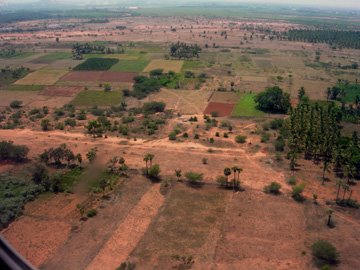
In the morning we flew to Madurai. This is what the land looked like as we descended:


The earth is red, and in many places the vegetation is sparse and scrubby. Rocky hillocks rise abruptly out of flat plain. I have flown over Tamil Nadu and into Kerala before, and each time I have felt the abruptness of the change: Tamil Nadu vast, dry, red -- it has fields, rice paddies, orchards, but they appear to be clinging to the surface of a hard land; then, cross the ghats - the low mountain range which runs up the western side of India - and BAM! Kerala, green, lush, abundant. Both landscapes have their own beauty, but Kerala's is more obvious.

This time we landed in Madurai, a temple city in the south of Tamil Nadu, and drove up the hills and into Kerala. (Here's a map. We started from Chennai, which is shown in blue, right on the northeast coast. Madurai is more than halfway down, more or less in the centre, and situated at a crossroads: a real heartland city. We drove west, through Theni, and just across the border into Kerala.)

Thekkady is 150 km from Madurai. The drive took 3 1/2 hours, most of it through flat plains – rocky outcroppings, fields, plantations of coconut, grapes, sugarcane; many small villages. Village temples, some of them protected by large painted sculptures of warriors on white horses.

In several places farmers had spread out hard cobs of millet on the road, to be threshed by the cars driving over them. Parts of the road were thickly lined with shady trees, their trunks painted in black and white warning stripes.

At one small village, a small procession emerged onto the road: about ten people. One man carried a red umbrella - tall, dome-shaped, intended to symbolise royalty or divinity. Behind him a woman carried two decorated brass pots on her head.

Later we passed another mini-procession in a larger village: a drummer, a couple of men in horse costumes, prancing.

The hills rise directly out of the plain. The ghat road ascends abruptly, much more steeply and directly than on the road to Coonoor. The road is less travelled than the road to Coonoor, which is often like a roller coaster ride, with cars flying in both directions on the same narrow track. A beautiful drive through forest, with views of green hills and valleys.


A few tiny villages are strung alongside the road. At Kumili village one leaves Tamil Nadu and enters Kerala by driving under a bar which extends across the road. This is where the hotels and resorts begin. In five minutes we were in Thekkady.

Thekkady 1

We just got back from two weeks in relatively cool Thekkady, a small town on the Kerala side of the Kerala-Tamil Nadu border (but not by much), which abuts a huge game sanctuary / forest. It is my earnest intention to post some drawings, words, photographs of the same over the next few days.


(This photograph is a cheat, actually, because as you can see, the drawing is different from the real flower's pose. I had drawn it on the tree first, but its face-on view was much more complex and amazing than its profile. So I plucked it and brought it back to our room, and did it again on watercolour paper.) And by the way, what is it? It's gorgeous, with a sheen like silk, and seems to grow wild on the roadside, on trees - or perhaps they're large shrubs... (update: thanks to Anna, who surmises that this is a datura.)

Hot


It's so hot the crows sit stunned on their branches. I'm going to see some elephants.

(The illustration is an imagined antique seed packet. Banyan seeds are actually quite small, if you were wondering.)

Moo


I confess that I drew this, not from life, but from a fuzzy old photograph taken by R, which we were going to throw away. It is a Chennai cow, anyway.

My father had several talents of interest to small children: he could wiggle his ears; he had a signet ring - we called it his magic ring - which he could make disappear; but most of all, he was really good at mooing. He was sparing in performing all of these wonders, so that they retained their desirability. But once in awhile we would say, "Make a moo, Daddy!" and he would oblige. It began with a long, deep "MMMMMMMM", and then extended out to "oooooooo", and it was very satisfactory indeed.

Several Things

R tells a story from his childhood -- about the herbal hair oil which his father brewed up for the family.


My post about the Armenian Church for Chennai Metroblogging


A book-binding demonstration: how to make an Indian-style financial ledger


Wonderful pictures on in Camera of the recently-ended Kapaleeswarar temple festival -- scattered over several posts - scroll down.


I heard about this from my sister, but she saw it on boingboing: It's a short video of an Indian traffic intersection. Boingboing's text reads in part
Here's a hypnotically captivating video of a congested street in India. The pedestrians, scooter drivers, impossibly tiny-car drivers, and huge-truck drivers seem to have ESP because everything flows so smoothly...

(I assume that by 'impossibly tiny cars' they're referring to the auto rickshaws.) When I saw this I had just finished driving to Kodambakkam and back in heavy traffic - one hour each way - and my first thought was, "You call this traffic? This is nothing!" But it does give an idea of how it is to drive here: you have to get into the flow of it, and then things (usually) move right along.


Overheard: "Some women age very quickly -- oxydation or whatever..."

A Gift II

I received several interesting comments / bits of information after my post about the little savoury mold that the paperkkaarar had given me (two posts back). They inspired me to actually use the mold; something which hadn't initially occurred to me.

We decided to make some turnovers (I don't know what to call them: they're certainly not samosas as I know them...), filled with the same filling used for potato bonda. Lakshmi made the turnovers, Mary fried them, and I took the pictures. Here's Lakshmi, sitting on the kitchen floor, where she has rolled out the maida (white flour) chappati, laid it over the mold, and is stuffing it with the potato mixture:


Here's the pressed, uncooked turnover. You can see the impressed design, but it's very faint:


And ta-da! Here is the final result - in which the design has disappeared completely - a luxurious tea of turnovers and strawberries. It was lovely.


Blogday


under the fire star is three years old today.

Here's my first post, from April 17, 2003:
The God of Death Sells Paint

I love this TV ad, and what it implies about how a culture can relate to its gods -- almost intimately, as if they were close relatives:


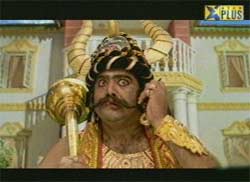
Yamraj, the God of Death, is a fat, bare-chested man with a big black moustache, riding a black buffalo. He wears a gilded crown and carries a gilded mace. He rides up to a householder , and tells him that it’s time to go. Desperate, the man begs, "I’ve just had my house painted. Please wait, and take me only when the house needs re-painting." Yamraj grants this boon. He sits astride his buffalo in front of the house for years, fuming with impatience. The householder’s son grows up and marries, and comes outside for Yamraj’s blessing and a group photo. Yamraj’s wife screams on the cell-phone: "Are you coming home or not?!" Furious, Yamraj calls out, "Rain!" and it rains, but the paint is not harmed. He calls out, "Heat!" and there is strong sunlight, but the paint is not harmed. The householder’s grandchild comes out to play, calling cheerfully, "Hello, Uncle!" Yamraj in despair asks him, "What paint is this, anyway?" The child says, "Nerolac!" Yamraj shouts, "Nerolac!" and a can of paint falls into his hands. He grimaces horribly at it. Fadeout.

There's a storyboard for this ad here.

A Gift

Yesterday the paperkkaarar came to buy our old newspapers, Diet Pepsi tins, magazines, empty bottles and so on. We usually call him in -- he cycles by with his cart every few days -- only after the shelves in the ironing room are bulging with stuff. Mary and Lakshmi haul more things out of Mary's room: bits of torn paper, scrap metal from valves and pipes which have been replaced, empty tins of canned corn, plastic milk sachets. The proceeds from this venture are shared among us, under a long-established system which I haven't fully figured out.

Yesterday Lakshmi was shaking the paperkkaarar's coarse burlap sack to make sure that it was empty, and this fell out:


The picture shows the actual size -- at least on my computer screen. It's a press for making sweets, or savoury snacks. I was attracted to the design inside. I said, "I'll buy this from you." The paperkkaarar said, "Go ahead, take it, no need to give anything."

So I received a gift yesterday. It fell from a sack. It is worth nothing, even to the paperkkaarar. And I'm ridiculously pleased with it.

Wall Painting

I drove out to do some errands today, determined that I would not return without at least one photograph. I was just rounding the corner from Kasturi Ranga Road into Cathedral Road, when a wall-painting of MGR (late filmstar-turned-politician) in his Douglas Fairbanks Jr. incarnation caught my eye.


My first thought was that you can tell elections are around the corner when they start trotting out images of MGR; then I wondered what he was doing in this neighbourhood. It’s true that the wall-painting was near the residence of the Chief Minister, who was at one time MGR’s political protégé, but on the other hand MGR’s appeal is mainly to the masses, and this was a wealthy area. I drove around in a circle, parked, and took pictures of the whole series of wall paintings.

They are an eclectic group, a backdrop to a vendor of wadais and tea, and a couple of tire and bicycle repairmen. Perhaps their customers are the target audience for the paintings. I photographed them in sequence — here, we are reading from right to left, beginning with MGR on the corner and moving backward:


Mother Teresa, with the Congress Party flag next on the right. To the right of the flag is the picture of MGR, shown above, representing the AIADMK Party — two political allies side by side


To the left of Mother Theresa, Jesus with collaged Ganesh calendar


Jesus abuts a cycle repair stand, with collaged filmstars


Ganesh and the Ka’aba